
What R-Value Really Means and Why It's Only Part of the Insulation Story

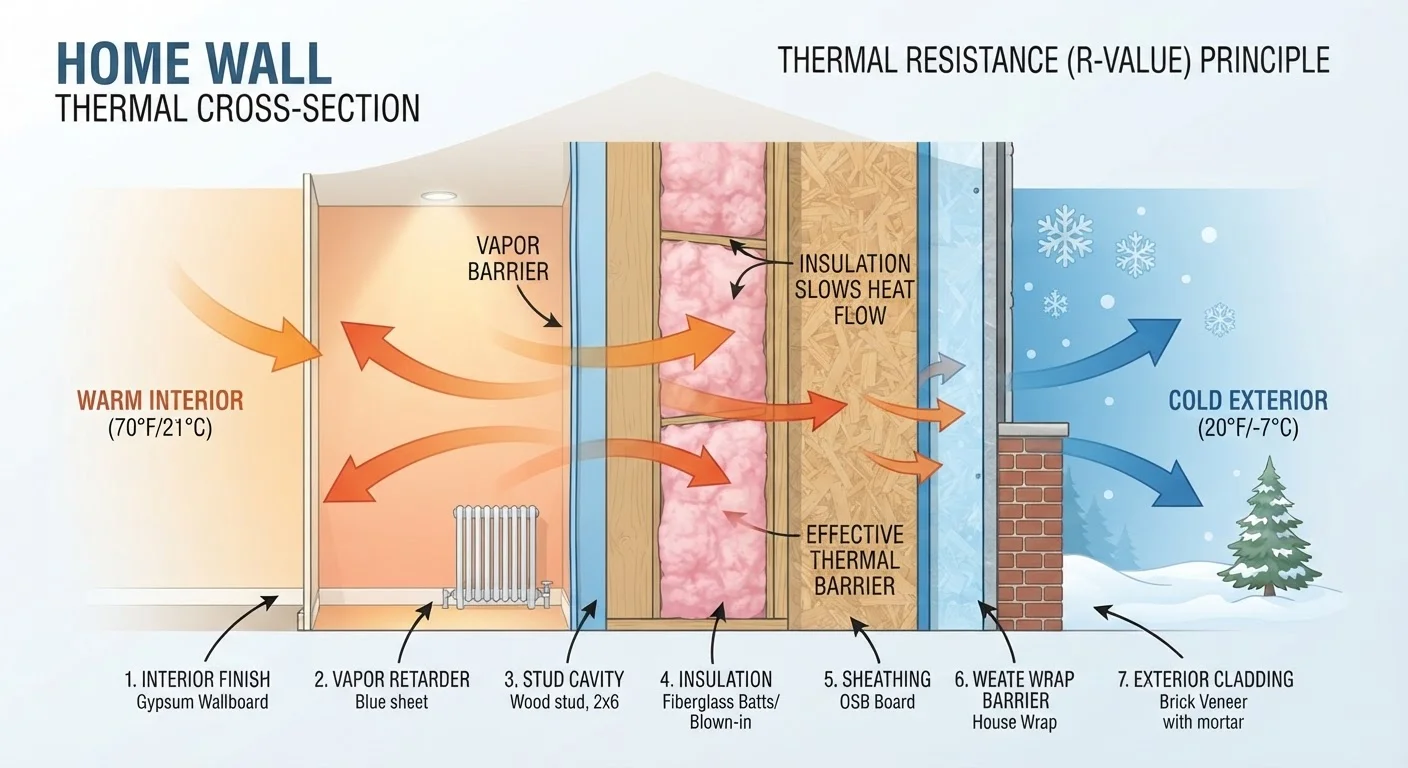
Photo: InsightsBlock.com | Access Information With Ease editorial
Key Takeaways
- R-value measures thermal resistance to heat flow - higher values mean better resistance.
- R-value is tested under ideal lab conditions, which rarely match real-world installation.
- Air leakage, moisture, and installation quality all significantly affect actual thermal performance.
- Different insulation types behave differently in real conditions, even at the same R-value.
- Building codes set minimum R-values by climate zone, but meeting the minimum isn't always optimal.
How R-Value Is Measured and What It Actually Tells You
R-value is determined in a controlled laboratory setting, where a material sample is placed between two temperature-controlled plates and the rate of heat transfer is measured. The result is a standardized number that tells you how much a given thickness of material resists conductive heat flow.
This measurement is genuinely useful - it allows builders and homeowners to compare insulation materials on a consistent scale. A roll of fiberglass batt rated R-13 provides a known, reproducible level of thermal resistance under those lab conditions. Building codes across the US use R-value as the primary benchmark for insulation requirements, broken out by climate zone.
However, the lab environment has limitations. Testing assumes still air, no moisture, and perfect material contact - conditions that rarely exist inside a real wall cavity or attic floor.
25-40%
Heat lost through air leakage in typical homes
According to the US Department of Energy, air infiltration accounts for roughly 25-40% of heating and cooling energy loss in a typical home - a factor entirely separate from R-value.
~20%
R-value reduction from thermal bridging
Research from Oak Ridge National Laboratory suggests that wood framing in standard wall construction can reduce the effective whole-wall R-value by approximately 15-20% compared to the cavity insulation's rated value.
R-30 to R-60
Recommended attic R-value range in the US
The US Department of Energy recommends attic insulation levels ranging from R-30 in warm southern climates to R-60 in the coldest northern regions, varying significantly by zone.
The Variables That R-Value Doesn't Capture
Once insulation leaves the factory, its real-world performance is shaped by factors the R-value rating cannot account for:
- Air leakage: R-value measures conductive heat flow through a material, not convective heat movement through gaps. Even a small unsealed gap around an electrical outlet or pipe penetration can dramatically reduce the effective thermal performance of an otherwise well-insulated wall.
- Installation quality: Compressed, torn, or improperly fitted batts lose a significant portion of their rated R-value. A fiberglass batt stuffed into a cavity that's too narrow performs well below its label.
- Moisture: Many insulation types - particularly cellulose and fiberglass - lose thermal effectiveness when wet. Moisture also creates conditions for mold growth and structural degradation.
- Thermal bridging: Wood studs, metal framing, and other structural elements conduct heat far more readily than the insulation between them. The overall performance of a wall assembly is always lower than the insulation's stated R-value because of these bridges.
Seal Before You Insulate
Why Insulation Type Still Matters at the Same R-Value
Two products can carry an identical R-value label and behave quite differently in practice. Spray foam, for instance, expands to fill irregular cavities and acts as an air barrier simultaneously - something rigid foam board and fiberglass batts don't do on their own. Closed-cell spray foam also has a high R-value per inch, making it practical where space is limited.
Mineral wool (also called rock wool or slag wool) is naturally resistant to moisture and doesn't lose significant R-value when damp. It also resists air movement better than standard fiberglass batts at the same rating. These material properties matter when choosing insulation for specific locations - a basement rim joist behaves very differently from an open attic floor.
For a deeper look at how these choices play out in a specific project, see our guide to attic insulation decisions, which covers how material selection, R-value targets, and air sealing work together.
Using R-Value as a Starting Point, Not a Final Answer
R-value is an indispensable planning tool - it helps you meet code requirements, compare products, and communicate with contractors. But treating it as the complete measure of insulation performance leads to incomplete decisions.
A practical approach combines R-value targets with attention to air sealing, vapor control, and installation quality. When evaluating insulation improvements, consider having an energy auditor assess your home using a blower door test, which measures actual air leakage rather than theoretical thermal resistance. This gives you a more complete picture of where heat is actually escaping.
R-value tells you how well a material resists heat under ideal conditions. What happens in your home depends on how that material is installed, what surrounds it, and how well the rest of the building envelope is sealed.
Frequently Asked Questions
The content provided on our blog site traverses numerous categories, offering readers valuable and practical information. Readers can use the editorial team’s research and data to gain more insights into their topics of interest. However, they are requested not to treat the articles as conclusive. The website team cannot be held responsible for differences in data or inaccuracies found across other platforms. Please also note that the site might also miss out on various schemes and offers available that the readers may find more beneficial than the ones we cover.