
Free vs. Paid Online Courses: Understanding What You Actually Get

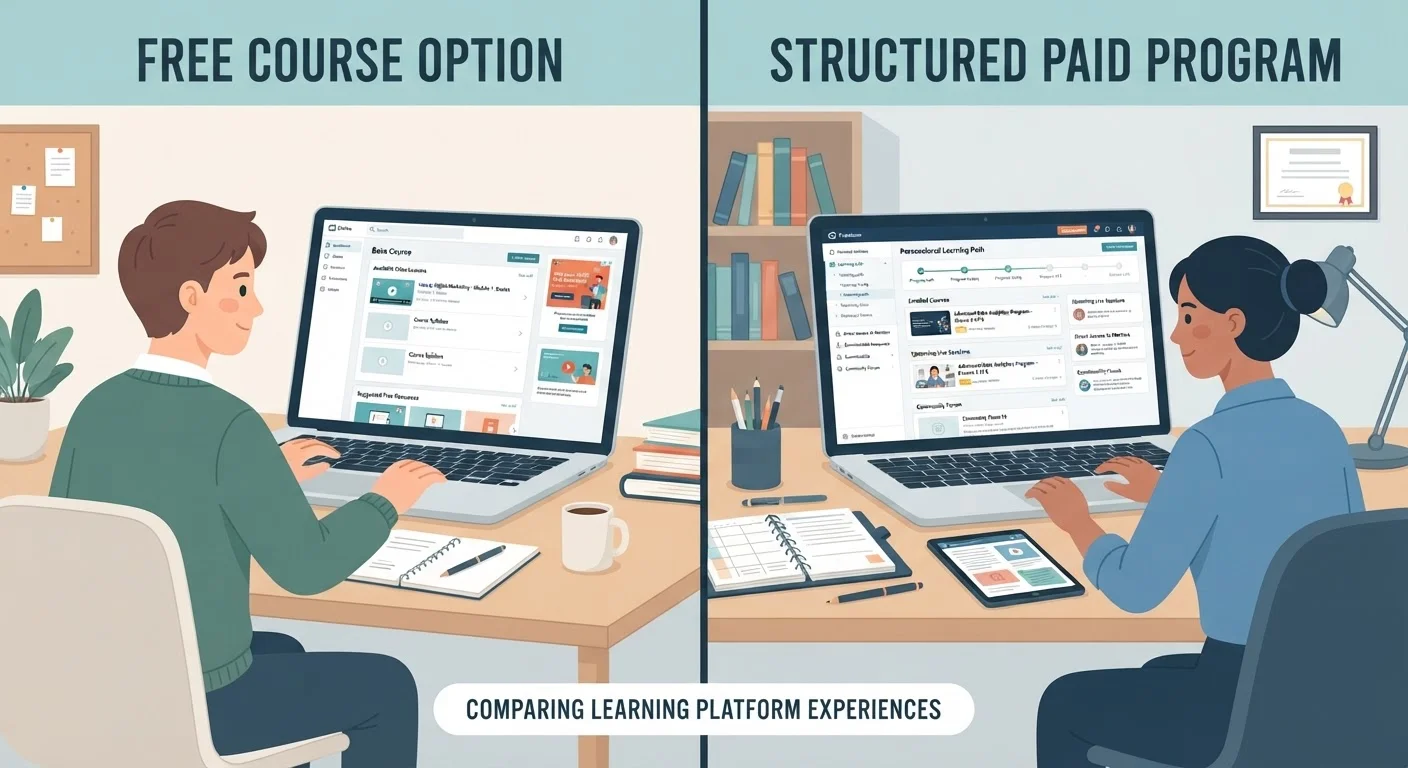
Photo: InsightsBlock.com | Access Information With Ease editorial
Key Takeaways
- Free courses provide content access but rarely include graded assessments, instructor feedback, or shareable certificates.
- Paid programs typically offer structured curricula, verified credentials, and learner support that free tiers omit.
- Credentials from paid programs vary widely in employer recognition - verify before enrolling.
- Auditing a free version first is a practical way to evaluate course quality before paying.
- Neither option is universally superior - your goal, timeline, and budget should guide the choice.
What Free Courses Actually Include
Many reputable platforms - including Coursera, edX, and Khan Academy - allow learners to audit course content at no cost. Auditing typically means access to video lectures, reading materials, and some quizzes. What it usually does not include: graded assignments, peer-reviewed projects, instructor feedback, or a certificate of completion.
This distinction matters. You can genuinely learn from free content, but the learning experience is often self-directed and unverified. There is no external accountability, no structured deadline, and no credential at the end. For someone exploring whether data analysis or UX design is the right career pivot, that trade-off is perfectly reasonable. For someone who needs proof of competency for a job application, it is a significant gap.
Free content quality also varies considerably. An open-access lecture from a university course and a free tier on a commercial platform are very different products. Before committing time, review the syllabus depth, check when the course was last updated, and read learner reviews. Our course evaluation checklist walks through exactly what to examine.
| Criterion | Free Online Courses | Paid Online Courses |
|---|---|---|
| Cost | No financial cost | Varies widely; $20 to thousands |
| Certificate or credential | Rarely included | Typically included; type varies |
| Graded assignments | Usually excluded on free tier | Generally included |
| Instructor or mentor feedback | Not typically available | Often available |
| Structured pacing | Self-directed | Often cohort-based or deadline-driven |
| Commitment level | Low; easy to start or stop | Higher; financial and time investment |
| Content quality | Varies significantly by provider | Varies; price does not guarantee quality |
What Paid Programs Add - and What to Verify
Paid online courses and programs typically layer several features on top of the base content: graded assessments, structured pacing, peer or instructor interaction, and - most visibly - a certificate. These additions are genuinely useful, but they are not uniformly valuable across providers.
The most important thing to verify before paying is what the credential actually represents. A certificate of completion confirms you finished a course. A professional certification involves a standardized, often proctored exam and is issued by an industry body. A digital badge sits somewhere in between. Employers and licensing bodies treat these very differently. Our article on certificates, certifications, and credentials explains how to tell them apart before you enroll.
Cost also varies enormously. Individual courses may run from under $20 to several hundred dollars. Subscription-based platforms charge monthly or annual fees. Degree-level programs can cost thousands. Higher price does not reliably signal better learning outcomes - it often reflects institutional overhead, brand recognition, or accreditation costs instead.
~49%
Adults who cite cost as barrier to education
According to Pew Research Center surveys, roughly half of U.S. adults who did not pursue further education cited cost as a significant obstacle.
1 in 3
Online learners who complete a course they start
Completion rates for free Massive Open Online Courses (MOOCs) have historically hovered well below 50%, according to research published in academic journals on distance education.
Making the Right Choice for Your Situation
The most practical approach is to treat free and paid tiers as complementary rather than competing. Audit a free version of a course to evaluate the instructor's style and the curriculum's depth. If the content aligns with your goals and the credential matters for your next step, then pay for full access or enroll in a paid program in the same subject area.
If you are weighing whether an online credential can substitute for a traditional degree in your field, that is a separate - and important - question. Our comparison of online certifications versus traditional degrees addresses that trade-off in depth. And if you are still orienting yourself among the many platforms available, our platform field guide provides a concise reference for what each major option offers and who it suits best.
Whatever you choose, set a clear learning objective before enrolling. Vague goals lead to abandoned courses - free or paid. A concrete outcome, such as completing a specific project or preparing for a certification exam, keeps your learning on track regardless of the format.
The content provided on our blog site traverses numerous categories, offering readers valuable and practical information. Readers can use the editorial team’s research and data to gain more insights into their topics of interest. However, they are requested not to treat the articles as conclusive. The website team cannot be held responsible for differences in data or inaccuracies found across other platforms. Please also note that the site might also miss out on various schemes and offers available that the readers may find more beneficial than the ones we cover.