
Short-Term vs. Long-Term Savings Goals: Matching Strategies to Timelines

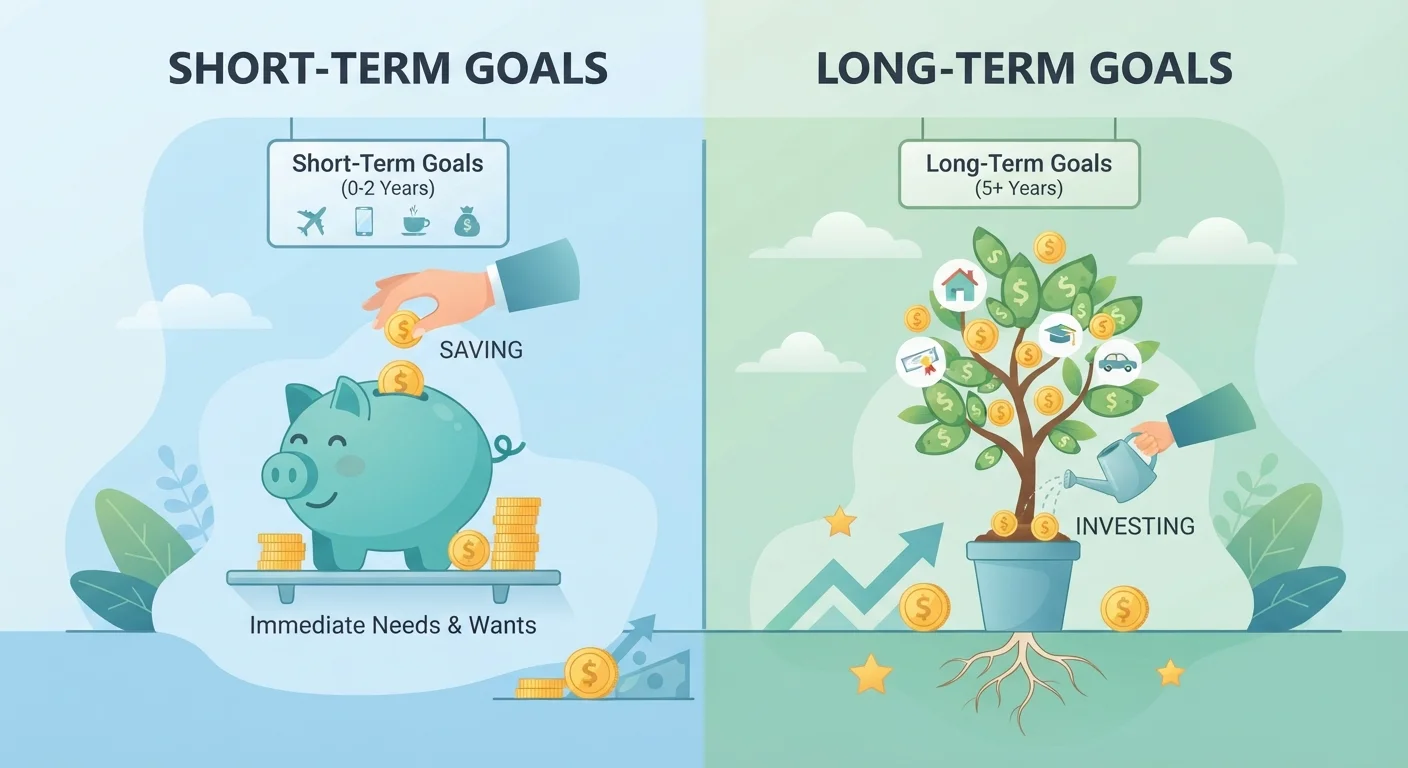
Photo: InsightsBlock.com | Access Information With Ease editorial
Key Takeaways
- Short-term goals (under 3 years) prioritize liquidity and capital preservation over growth.
- Long-term goals benefit from compound growth, making tax-advantaged accounts especially powerful.
- Mixing strategies - liquid accounts for near goals, invested accounts for distant ones - reduces both risk and missed opportunity.
- Automating contributions aligned to each goal's timeline reduces decision fatigue and improves follow-through.
- Time horizon, not just dollar amount, should drive your choice of savings vehicle.
Why Timeline Is the Starting Point, Not the Dollar Amount
Most people approach savings goals by asking, "How much do I need?" That's a reasonable question - but the more consequential one is, "When do I need it?" Your timeline determines which accounts make sense, how much risk is appropriate, and whether growth or preservation should take priority.
A vacation fund you'll spend in 14 months and a retirement account you won't touch for 25 years require completely different logic. Put retirement savings in a savings account and you leave decades of compound growth on the table. Put a vacation fund in a volatile investment account and you risk needing to sell at a loss right when you need the cash.
Defining a goal's timeline upfront - before choosing any vehicle - is the foundational step that everything else depends on. If you're still building the discipline to save consistently, see our guide to building a savings habit on a tight budget.
Short-Term Goals: Liquidity and Safety First
Short-term goals typically fall within a one-to-three-year window. Common examples include an emergency fund, a planned vacation, a car down payment, or a home repair reserve. For these goals, two properties matter most: liquidity (you can access the money quickly without penalty) and capital preservation (the balance doesn't drop when you need it).
High-yield savings accounts (HYSAs) are a natural fit here. They offer meaningful interest compared to traditional savings accounts while keeping funds accessible. Comparing HYSAs to traditional savings accounts shows just how wide the rate gap can be - and why that difference matters over even a short time horizon.
Certificates of deposit (CDs) work well when you have a fixed deadline and won't need early access. A 12-month CD for a vacation you're planning next year locks in a known rate. Just be aware that early withdrawal penalties can eat into earnings if plans change. For a balanced look at CD trade-offs, see our overview of what CDs offer and where they fall short.
| Short-Term (0-3 yrs) | Medium-Term (3-7 yrs) | Long-Term (10+ yrs) | |
|---|---|---|---|
| Primary priority | Liquidity & preservation | Balanced growth & access | Maximum growth |
| Typical vehicles | HYSA, short-term CD | CD ladder, I-bonds, conservative brokerage | 401(k), IRA, 529 plan |
| Risk tolerance | Very low | Low to moderate | Moderate to high |
| Tax advantages | Minimal | Limited (I-bonds deferred) | Significant (tax-deferred or tax-free) |
| Early withdrawal penalty | Usually none (HYSA) | Possible (CD penalty) | Yes, often significant |
| Role of compounding | Minor | Moderate | Critical |
Long-Term Goals: Growth and Tax Efficiency Take Over
Long-term goals - generally ten or more years away - shift the calculus entirely. With a long runway, short-term market fluctuations matter less, and the compounding effect of investment returns becomes the dominant variable. Capital preservation is no longer the priority; growth is.
Tax-advantaged accounts are the workhorses here. A 401(k) or traditional IRA reduces taxable income today and lets investments grow tax-deferred. A Roth IRA or Roth 401(k) foregoes the upfront tax break in exchange for tax-free withdrawals in retirement - a meaningful distinction depending on your expected future tax bracket. For education goals, a 529 plan offers tax-free growth when funds are used for qualified expenses.
The mechanics of compounding reward patience: money invested earlier has more time to grow, which means consistent contributions started young outperform larger contributions started late. This is why automating contributions to long-term accounts is one of the highest-leverage habits in personal finance - it removes the friction that causes people to delay.
Time in the Market Beats Timing the Market
The Middle Ground: Goals 3-7 Years Out
Medium-term goals - a home down payment, a major renovation, or funding a business in five years - don't fit neatly into either category. They're too close to absorb significant market losses, but too far away to settle for the modest returns of a basic savings account.
Several approaches can help split the difference. A CD ladder staggers multiple CDs with different maturity dates, giving you periodic liquidity while capturing higher rates on longer-term deposits. Series I savings bonds (I-bonds), issued by the U.S. Treasury, offer inflation-adjusted returns with a one-year minimum holding period - useful for goals four or more years away. A conservative allocation in a taxable brokerage account - heavily weighted toward bonds or stable value funds - is another option, though it carries market risk that a CD or I-bond does not.
Wherever surplus cash ends up, it's worth thinking through whether saving or paying down high-interest debt should come first. Our analysis of saving vs. debt payoff walks through how to make that call based on interest rates and your existing cushion.
Running Multiple Goals at Once
Most households don't have the luxury of saving for one goal at a time. You might be building an emergency fund, saving for a vacation, and contributing to a 401(k) simultaneously - each on a different timeline, each requiring a different vehicle.
The practical solution is to treat each goal as its own savings bucket with its own account and automated contribution. Separate accounts reduce the temptation to raid one goal for another, and they make progress visible. Automation keeps contributions consistent regardless of willpower or competing expenses. For readers looking at how habit design reinforces these structures, research on savings habits that tend to stick offers useful context.
Prioritization matters when cash is limited. A common framework: fund a basic emergency reserve first, capture any employer 401(k) match (it's an immediate return on contribution), then direct remaining dollars toward near-term goals before adding to longer-term taxable investing. The exact order depends on your interest rates, tax situation, and personal priorities - a licensed financial adviser can help you sequence decisions specific to your circumstances.
This article is for general informational and educational purposes only and does not constitute personalized financial, investment, or tax advice. Consult a qualified financial professional before making decisions about your own savings or investment strategy.
The content provided on our blog site traverses numerous categories, offering readers valuable and practical information. Readers can use the editorial team’s research and data to gain more insights into their topics of interest. However, they are requested not to treat the articles as conclusive. The website team cannot be held responsible for differences in data or inaccuracies found across other platforms. Please also note that the site might also miss out on various schemes and offers available that the readers may find more beneficial than the ones we cover.