
Leasing vs. Buying: Mapping the Cost Differences Over Time

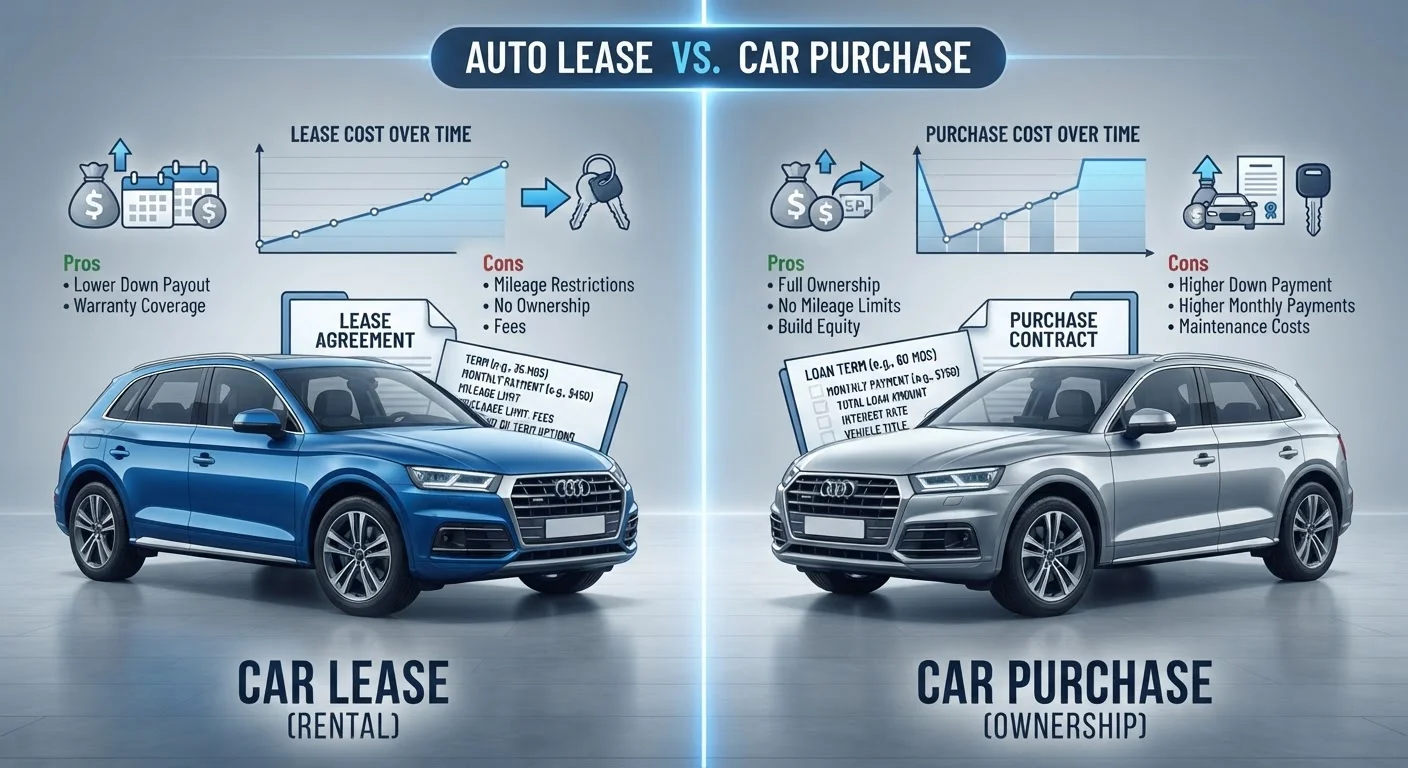
Photo: InsightsBlock.com | Access Information With Ease editorial
Key Takeaways
- Lease payments are typically lower month to month, but you own nothing at the end of the term.
- Buying costs more upfront and in early monthly payments, but builds equity over time.
- Over ten years, buying and holding a vehicle is generally the lower-cost path for most drivers.
- Mileage limits and wear-and-tear fees can significantly inflate the real cost of leasing.
- Your driving habits and financial priorities should drive the decision, not monthly payment size alone.
What You're Actually Paying For
The monthly payment is the figure that dominates most leasing versus buying conversations - and that framing creates a persistent misunderstanding. When you lease, you are paying for the vehicle's depreciation during your lease term, plus a finance charge (often called the money factor) and fees. When you buy with a loan, you are paying down the full purchase price - but at the end of the loan, you hold an asset outright.
That structural difference matters enormously over longer time horizons. Lease payments feel affordable because you're only financing a portion of the car's value. But that portion is gone at lease-end - along with the vehicle. For a deeper look at every cost layer involved in car ownership, see The Full Financial Picture of Car Ownership.
| Criterion | Leasing | Buying |
|---|---|---|
| Monthly payment | Lower (depreciation only) | Higher (full purchase price) |
| Upfront costs | Cap cost reduction + fees | Down payment + taxes/title |
| Ownership at end of term | None - vehicle returned | Full ownership of asset |
| Mileage flexibility | Capped; overages cost extra | Unlimited |
| Customization | Generally not permitted | Owner's discretion |
| Long-term cost (10 years) | Higher - continuous payments | Lower - payment-free period after payoff |
| Resale / equity risk | None - insulated from depreciation | Owner absorbs depreciation risk |
| Maintenance responsibility | Sometimes included in lease | Fully owner's responsibility |
How the Numbers Diverge at Three, Five, and Ten Years
The cost comparison between leasing and buying shifts dramatically depending on the time horizon you're evaluating.
At Three Years
Over a standard 36-month lease, total out-of-pocket costs are often comparable to - or only modestly lower than - financing the same vehicle. The lease requires a smaller monthly payment but typically demands a down payment (called a cap cost reduction), acquisition fees, and a disposition fee at the end. A loan buyer pays more each month but has built meaningful equity by month 36.
At Five Years
A driver who leases re-enters the market after 36 months and begins a second lease. They now face the current market's prices and money factors. The buyer, by contrast, may have fully paid off a 60-month loan and transitioned to a zero-payment period. That payment-free stretch is one of the most significant financial advantages of buying.
At Ten Years
A driver who leases continuously across a decade will have made 120 months of payments with no vehicle equity to show. A buyer who purchased and held for ten years owns an asset - depreciated, yes, but sellable. Industry data generally shows that long-term vehicle ownership is the lower-cost path when the same vehicle is held well past its loan payoff date.
~30%
Typical lease payment discount vs. loan payment
Industry estimates generally show lease payments running 20-40% lower than loan payments on equivalent vehicles, primarily because you finance only the depreciation portion.
$0.25
Common per-mile overage fee
Many standard lease agreements charge $0.15-$0.30 per mile over the annual limit; at 5,000 over-miles, that alone can mean $750-$1,500 at lease return.
11+ years
Average age of vehicles on US roads
According to S&P Global Mobility data, the average age of light vehicles in operation in the US has risen above 11 years, underscoring how long many drivers actually hold their vehicles.
For a look at how fuel costs layer on top of these ownership structures, see what the lifetime fuel math actually shows.
The Hidden Variables That Change the Math
Several costs sit outside the headline monthly payment and can tip the comparison significantly in either direction.
- Mileage overages: Lease contracts typically allow 10,000-12,000 miles per year. Overage fees commonly run $0.15-$0.30 per mile, which can generate a substantial bill at lease return.
- Wear-and-tear charges: Lessees are responsible for returning the vehicle in acceptable condition. Dents, tire wear, and interior damage beyond normal use carry fees assessed at inspection.
- Insurance premiums: Leased vehicles often require higher liability limits and lower deductibles, which can modestly increase insurance costs versus a vehicle you own outright.
- Maintenance inclusion: Some lease agreements include scheduled maintenance, which adds real value to the calculation. Buyers absorb all maintenance costs themselves.
- Residual value risk: Buyers bear the risk that a vehicle's resale value underperforms expectations. Lessees hand the vehicle back and are insulated from that risk - but also cannot benefit if the car holds value well.
Keeping car costs in check over the long haul covers practical strategies that apply whether you lease or own.
Tax Considerations Vary by Use Case
Matching the Choice to Your Situation
Neither leasing nor buying is objectively superior - the right answer depends on how you use a vehicle and what financial outcome you're optimizing for. Drivers who put on high mileage, customize their vehicles, or want to build long-term savings through eliminated payments are generally better served by buying. Drivers who value predictable costs, lower monthly payments, and the option to drive newer cars with the latest features may find leasing aligns better with their priorities.
One useful exercise: calculate the total out-of-pocket cost of each path over a realistic horizon - say, nine years, representing three 36-month leases versus one purchased vehicle driven to 100,000 miles. Include all fees, not just the monthly payment. Annual car ownership costs by vehicle type can help you benchmark expected expenses for the category of vehicle you're considering. And if the new-versus-used dimension is also part of your decision, the new car vs. used car cost comparison adds important context.
This article is for general informational purposes only and does not constitute financial or legal advice. Vehicle costs vary by model, region, credit profile, and market conditions. Consult a qualified financial adviser for guidance tailored to your individual circumstances.
The content provided on our blog site traverses numerous categories, offering readers valuable and practical information. Readers can use the editorial team’s research and data to gain more insights into their topics of interest. However, they are requested not to treat the articles as conclusive. The website team cannot be held responsible for differences in data or inaccuracies found across other platforms. Please also note that the site might also miss out on various schemes and offers available that the readers may find more beneficial than the ones we cover.