
Stress vs. Anxiety: Knowing the Difference in Your Own Life

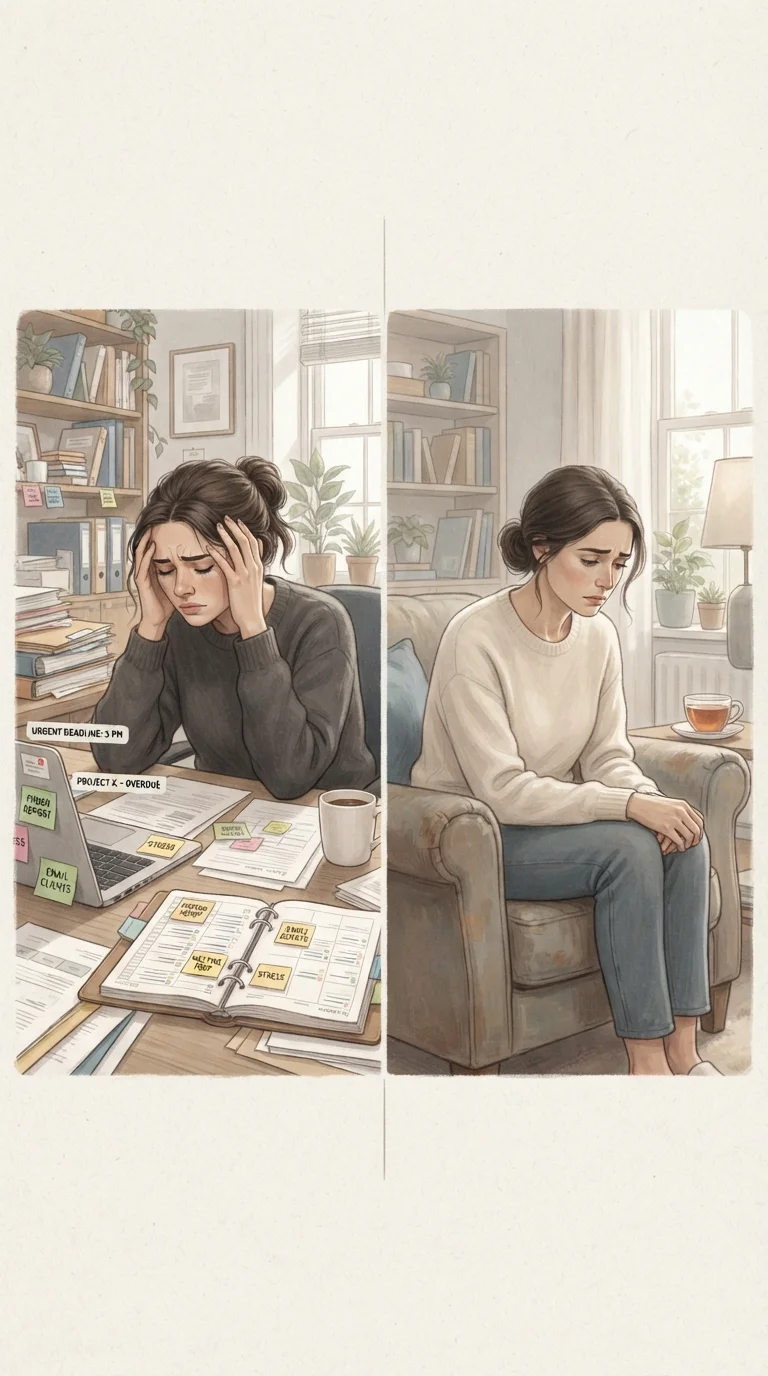
Photo: InsightsBlock.com | Access Information With Ease editorial
Key Takeaways
- Stress is typically tied to a specific, identifiable external trigger and tends to ease when that trigger resolves.
- Anxiety often persists beyond the triggering event or occurs without a clear external cause.
- Both share physical symptoms like muscle tension and disrupted sleep, making self-awareness essential for telling them apart.
- Neither condition should be dismissed - both can affect quality of life and merit thoughtful self-care.
- Persistent or severe symptoms of either stress or anxiety warrant a conversation with a qualified healthcare professional.
Why the Distinction Matters
Stress and anxiety are among the most common words people use to describe emotional discomfort - and they're frequently used interchangeably. That's understandable: both involve tension, worry, and a sense that something is wrong. But treating them as identical can lead to self-care choices that miss the mark.
Understanding which experience you're having isn't about labeling yourself or reaching a diagnosis. It's about building enough self-awareness to respond in a way that actually helps. Stress usually calls for addressing what's in front of you; anxiety may call for different strategies that interrupt unhelpful thought patterns rather than eliminating a trigger. Knowing the difference is a practical tool, not a clinical one.
This article provides general mental wellness education only and is not a substitute for professional medical or psychological advice. If you are experiencing significant or persistent symptoms, please consult a qualified healthcare professional.
What Stress Looks Like
Stress is a normal physiological and psychological response to a perceived demand or threat. Its defining feature is the identifiable external trigger - an overloaded work schedule, an argument with a partner, a financial pressure, an illness in the family. When that trigger is present, the body activates its stress response: heart rate rises, muscles tighten, attention narrows.
Crucially, stress tends to be time-limited. Once the triggering situation resolves - the deadline passes, the conflict is addressed - the physical and emotional symptoms typically ease. This doesn't mean stress is trivial. Chronic stress, where triggers are ongoing and unrelenting, can wear down the body and mind over time. But the pattern of stress generally tracks with circumstances you can point to.
| Criterion | Stress | Anxiety |
|---|---|---|
| Primary cause | Identifiable external trigger | Often internal, anticipatory, or unclear |
| Duration | Eases when trigger resolves | Persists beyond the trigger or situation |
| Nature of worry | Proportionate to the situation | Can feel excessive or hard to control |
| Physical symptoms | Tension, fatigue, sleep disruption | Similar, plus restlessness or sense of dread |
| Focus of concern | Present demands and pressures | Future threats, often vague or shifting |
| Self-care emphasis | Address or reduce the source | Interrupt thought patterns, calm nervous system |
What Anxiety Looks Like
Anxiety shares many of the same physical sensations as stress - racing heart, shallow breathing, muscle tension, sleep disruption. The key difference lies in its relationship to a specific cause. Anxiety is often described as anticipatory and free-floating: it can arise without a clear, present trigger, persist after a stressor has passed, or shift quickly from one worry to another.
Where stress says "I'm overwhelmed because of this specific thing," anxiety often says "something bad might happen, though I can't quite name what." This quality of worry - disproportionate to the situation, difficult to control, and persistent - is what distinguishes anxiety as a distinct pattern. Anxiety exists on a spectrum, from everyday apprehension to clinical anxiety disorders, which are diagnosable conditions assessed and treated by licensed mental health professionals.
Practices that interrupt rumination - such as mindfulness or structured breathing - are frequently discussed in the context of anxiety management. Our guide to meditation vs. mindfulness explains how each approach differs and may be helpful here.
Practical Self-Check: Reading Your Own Patterns
Because the symptoms overlap, paying attention to the pattern is more useful than cataloging symptoms. Ask yourself:
- Is there a clear trigger? Stress usually has one. Anxiety may not.
- Does it resolve when the situation changes? Stress typically does. Anxiety often continues or finds a new focus.
- How long has it lasted? Acute stress tends to be short-lived; persistent worry lasting weeks is worth discussing with a professional.
- Is the worry proportionate? Stress responses usually feel commensurate with the difficulty at hand; anxiety can feel excessive relative to the actual situation.
A structured mental wellness self-check-in can help you notice these patterns more consistently over time.
~33%
US adults reporting extreme stress levels
The American Psychological Association's Stress in America surveys have consistently found that roughly a third of US adults report high levels of stress affecting their health.
19.1%
US adults affected by anxiety disorders annually
According to the Anxiety and Depression Association of America, anxiety disorders affect approximately 19% of the US adult population each year, making them the most common mental health condition.
~50%
People with anxiety who don't seek treatment
Despite being highly treatable, the ADAA estimates that only about one-third of those with anxiety disorders receive professional treatment.
Self-Care That Respects the Difference
Many healthy habits - regular physical movement, adequate sleep, social connection, limiting caffeine and alcohol - support wellbeing regardless of whether you're dealing with stress or anxiety. But the focus of your self-care may differ.
For stress, addressing the source when possible is often the most effective step: problem-solving, setting boundaries, delegating tasks, or simply acknowledging a difficult season. For anxiety, strategies that calm the nervous system and interrupt repetitive thought patterns - such as diaphragmatic breathing, grounding techniques, or mindfulness practices - are more directly targeted to the experience.
It's also worth noting that self-care practices meant to soothe can sometimes shift into avoidance. Our piece on when self-care becomes avoidance explores how to tell the difference between restorative habits and those that quietly delay emotional processing.
When stress or anxiety is significantly affecting your daily life, work, or relationships, or when symptoms feel unmanageable, the most important step is speaking with a licensed mental health professional. Self-education is a starting point - professional support is what helps many people move forward.
The content provided on our blog site traverses numerous categories, offering readers valuable and practical information. Readers can use the editorial team’s research and data to gain more insights into their topics of interest. However, they are requested not to treat the articles as conclusive. The website team cannot be held responsible for differences in data or inaccuracies found across other platforms. Please also note that the site might also miss out on various schemes and offers available that the readers may find more beneficial than the ones we cover.