
Weighted Blankets, Breathing Apps, and Other Wellness Tools: Separating Signal from Hype

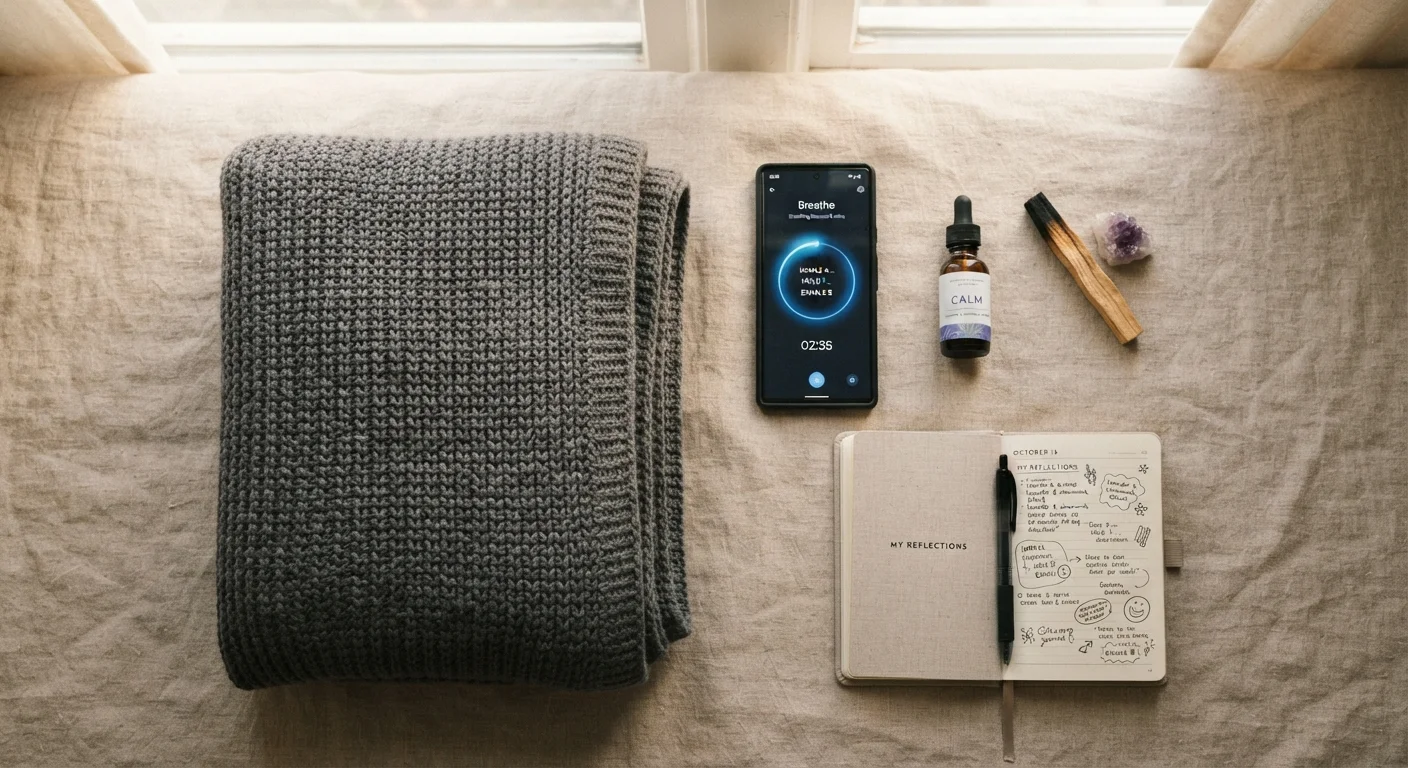
Photo: InsightsBlock.com | Access Information With Ease editorial
Key Takeaways
- Weighted blankets have modest but real research support for reducing anxiety symptoms in some adults.
- Breathing apps can be effective if they teach evidence-based techniques like diaphragmatic or paced breathing.
- Many wellness products rely on marketing language that outpaces the available scientific evidence.
- No single tool replaces professional mental health care for clinical conditions.
- The most effective wellness tools tend to reinforce behaviors - like sleep hygiene or stress response - that already have strong evidence.
Backed by plausible physiological mechanisms
Tools like weighted blankets and breathing apps engage well-understood body systems - deep pressure stimulation and autonomic nervous system regulation - giving their effects a credible biological rationale.
Low-risk additions to everyday routines
Most mainstream wellness tools carry minimal side-effect risk for healthy adults, making them reasonable low-stakes complements to existing habits like sleep hygiene or stress management.
Can reinforce evidence-based behaviors
Apps and devices that prompt breathing exercises or consistent sleep schedules help users practice techniques that already have strong independent research support.
Accessible without clinical referral
Many tools are available without a prescription or appointment, lowering the barrier for people who want to take a proactive role in managing everyday stress and sleep.
Modest but real research support for some categories
Weighted blankets, light therapy lamps, and paced breathing techniques each have a body of peer-reviewed research - however limited - indicating genuine benefit for specific, bounded outcomes.
Marketing claims routinely outpace evidence
Many wellness products use language like "clinically proven" or "doctor-recommended" without citing rigorous, independent research, making it difficult for consumers to assess real efficacy.
Not a substitute for professional mental health care
Wellness tools address everyday stress and mild discomfort - they are not appropriate as standalone responses to clinical anxiety, depression, trauma, or other conditions requiring professional treatment.
Effects are often modest and individual
Research on tools like aromatherapy or wearable stress monitors frequently shows high variability between individuals, meaning a tool that helps one person may offer little to another.
Cost can be significant relative to thin evidence
Some wellness devices and subscriptions carry substantial price tags despite limited or preliminary research, creating a mismatch between financial investment and demonstrated benefit.
Risk of replacing, not supplementing, healthy habits
Relying on a gadget or app can create a false sense of action while displacing higher-value behaviors like regular movement, quality sleep, or social connection.
Why Wellness Tools Are Worth Evaluating Carefully
The consumer mental wellness market has expanded dramatically, offering everything from weighted blankets and white noise machines to AI-powered mood trackers. Many of these products are harmless, and some are genuinely helpful. The challenge is that marketing claims frequently move ahead of peer-reviewed research, leaving consumers without a reliable compass.
A useful starting point is to ask: does this tool work with a mechanism the body already uses? Tools that tap into well-understood physiological or psychological processes - like the calming effect of slow, controlled breathing on the nervous system - tend to have stronger rationale behind them. Tools that promise vague outcomes like "balance" or "healing energy" without explaining a plausible mechanism deserve more scrutiny.
This article is for general informational purposes only and is not a substitute for professional mental health advice, diagnosis, or treatment. If you are experiencing significant mental health symptoms, please consult a qualified healthcare professional.
Weighted Blankets: What the Research Actually Shows
Weighted blankets - typically filled with glass beads or plastic pellets to add evenly distributed pressure - are designed around a concept called DPS. The idea is that gentle, firm pressure on the body activates the parasympathetic nervous system, the branch associated with rest and calm.
Several small-to-moderate studies have found that weighted blankets may help reduce self-reported anxiety and improve sleep onset in some adults. Research published in occupational therapy and sleep medicine contexts has shown promising results, though study sizes tend to be modest and findings aren't universally consistent. They are not a clinical intervention for anxiety disorders or insomnia.
Backed by plausible physiological mechanisms
Tools like weighted blankets and breathing apps engage well-understood body systems - deep pressure stimulation and autonomic nervous system regulation - giving their effects a credible biological rationale.
Low-risk additions to everyday routines
Most mainstream wellness tools carry minimal side-effect risk for healthy adults, making them reasonable low-stakes complements to existing habits like sleep hygiene or stress management.
Can reinforce evidence-based behaviors
Apps and devices that prompt breathing exercises or consistent sleep schedules help users practice techniques that already have strong independent research support.
Accessible without clinical referral
Many tools are available without a prescription or appointment, lowering the barrier for people who want to take a proactive role in managing everyday stress and sleep.
Modest but real research support for some categories
Weighted blankets, light therapy lamps, and paced breathing techniques each have a body of peer-reviewed research - however limited - indicating genuine benefit for specific, bounded outcomes.
On the limitations side, weighted blankets are not suitable for everyone. People with certain respiratory, circulatory, or claustrophobia-related concerns should check with a healthcare provider before use.
Marketing claims routinely outpace evidence
Many wellness products use language like "clinically proven" or "doctor-recommended" without citing rigorous, independent research, making it difficult for consumers to assess real efficacy.
Not a substitute for professional mental health care
Wellness tools address everyday stress and mild discomfort - they are not appropriate as standalone responses to clinical anxiety, depression, trauma, or other conditions requiring professional treatment.
Effects are often modest and individual
Research on tools like aromatherapy or wearable stress monitors frequently shows high variability between individuals, meaning a tool that helps one person may offer little to another.
Cost can be significant relative to thin evidence
Some wellness devices and subscriptions carry substantial price tags despite limited or preliminary research, creating a mismatch between financial investment and demonstrated benefit.
Risk of replacing, not supplementing, healthy habits
Relying on a gadget or app can create a false sense of action while displacing higher-value behaviors like regular movement, quality sleep, or social connection.
Breathing Apps: Useful Technique Delivery or Digital Distraction?
Paced and diaphragmatic breathing are among the best-supported non-pharmacological tools for short-term stress reduction. The evidence behind slow, controlled breathing - particularly techniques that extend the exhale - is well-established in psychophysiology research. The question with apps is whether they reliably teach these techniques or simply add a layer of gamification that wears off quickly.
~5-6
Breaths per minute in coherence breathing
Research in psychophysiology has linked breathing at approximately five to six cycles per minute with increased heart rate variability, a marker of parasympathetic nervous system activity.
15-30 lbs
Typical weighted blanket range used in studies
Most occupational therapy and sleep research on weighted blankets has used products in the 15 to 30 pound range, generally representing roughly 10% of the user's body weight.
Apps that guide users through box breathing (equal counts of inhale, hold, exhale, hold) or coherence breathing (roughly five to six breaths per minute) align with techniques that have demonstrated effects on heart rate variability, a marker of autonomic nervous system regulation. Apps that offer these as the core feature have a stronger claim to usefulness than those built primarily around passive soundscapes or loosely defined "mindfulness" sessions.
Pairing a breathing practice with a consistent daily routine can reinforce the habit and improve the chance it becomes a lasting stress management tool.
Other Common Wellness Tools: Signal vs. Noise
Beyond blankets and apps, the wellness space includes white noise machines, light therapy lamps, aromatherapy diffusers, and wearable stress monitors. Each warrants its own honest assessment.
- Light therapy lamps: Well-supported for seasonal mood shifts related to reduced daylight exposure. The mechanism - resetting circadian rhythm via light - is clearly understood.
- White noise machines: Evidence supports their role in improving sleep environment quality, particularly in noisy settings. The effect is largely environmental rather than physiological.
- Aromatherapy diffusers: Some studies suggest certain scents (lavender, for example) may have mild, short-term calming effects, but the evidence base is modest and effects vary significantly by individual.
- Wearable stress monitors: These measure proxies like heart rate variability or skin conductance. The data can be informative, but interpretation requires context - high readings don't necessarily indicate clinical stress.
For a self-directed complement to any of these tools, a structured self-check-in can help you notice patterns in how different approaches are - or aren't - affecting your wellbeing. You might also consider journaling approaches as a low-cost, evidence-adjacent practice that many people find grounding.
A Note on "Clinically Proven" Language
How to Evaluate Any Wellness Tool Before You Commit
A few practical questions can help cut through wellness marketing noise:
- Is there a plausible mechanism? Can the product explain how it works in terms of physiology or psychology - not just what it claims to do?
- What kind of evidence exists? Randomized controlled trials carry more weight than testimonials or a single small study. Look for research published in peer-reviewed journals.
- Are the claims specific or vague? Specific, bounded claims ("may support sleep onset") are more trustworthy than sweeping ones ("transforms your wellbeing").
- Is it low-risk? Many wellness tools are low-risk additions to an existing routine. Higher-risk or costly tools require a higher evidence bar.
Physical movement is also a well-evidenced contributor to mental wellbeing. If you're building a fuller wellness picture, it's worth exploring movement habits beyond step count for a more complete view of how activity supports mood and stress regulation.
This article is intended for general informational and educational purposes only. It is not medical or mental health advice. Always consult a qualified healthcare professional before making decisions about your health or wellness care.
The content provided on our blog site traverses numerous categories, offering readers valuable and practical information. Readers can use the editorial team’s research and data to gain more insights into their topics of interest. However, they are requested not to treat the articles as conclusive. The website team cannot be held responsible for differences in data or inaccuracies found across other platforms. Please also note that the site might also miss out on various schemes and offers available that the readers may find more beneficial than the ones we cover.