
The Real Trade-Offs of Learning Online Versus in a Classroom

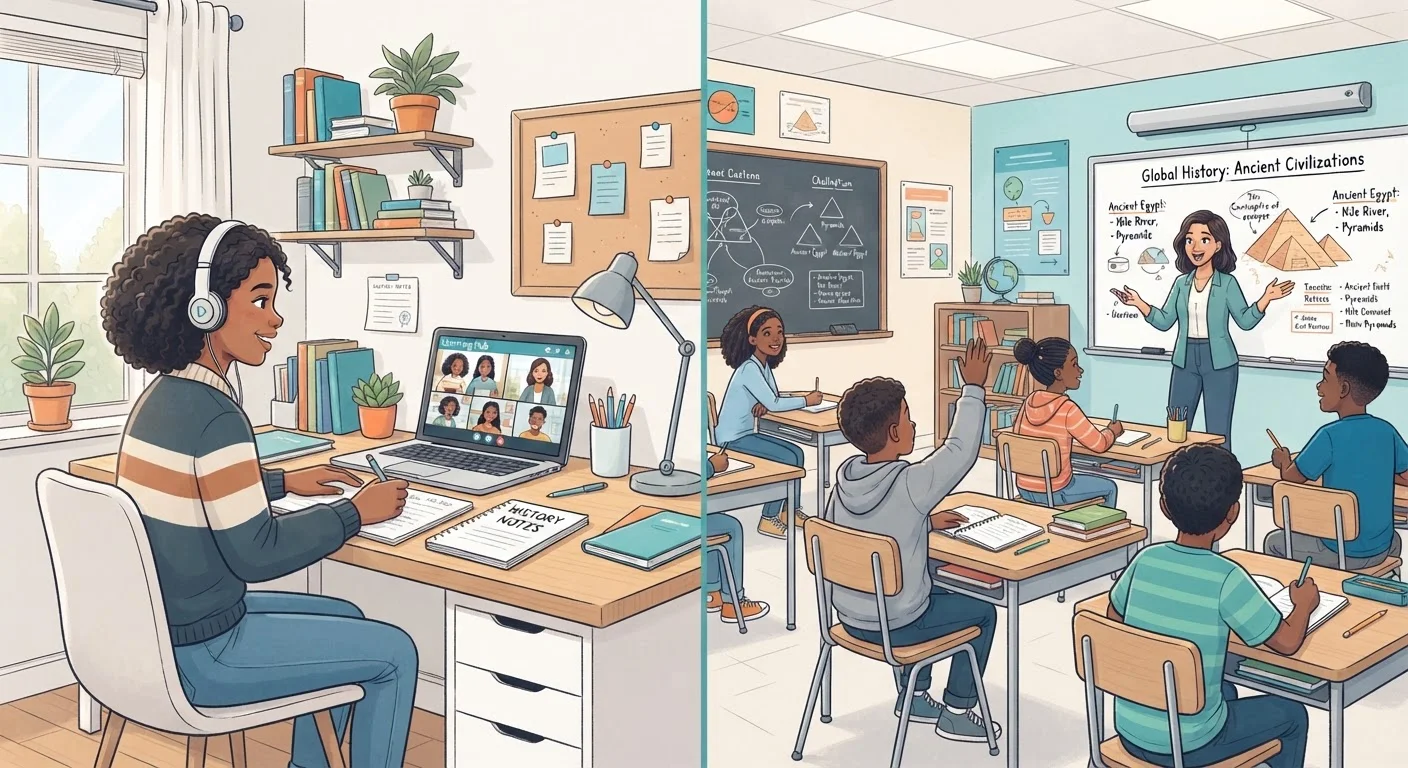
Photo: InsightsBlock.com | Access Information With Ease editorial
Key Takeaways
- Online learning offers greater schedule flexibility but demands strong self-discipline to complete coursework.
- Classroom learning provides structured accountability and real-time interaction that many learners depend on.
- Neither format is universally superior - the right choice depends on your subject, goals, and learning style.
- Hybrid programs increasingly blend both formats, offering a middle path for some learners.
- Cost differences between online and in-person programs vary widely and should be verified with specific institutions.
Schedule flexibility for working adults and caregivers
Asynchronous online courses allow learners to study outside traditional business hours, making education accessible to those with jobs, children, or irregular schedules.
Access to a wider range of subjects and instructors
Online platforms remove geographic barriers, giving learners in any location access to specialized courses and instructors that would otherwise require relocation.
Ability to revisit and review recorded content
Unlike live lectures, recorded lessons can be paused, rewound, and replayed, which can support comprehension for complex or unfamiliar material.
Potentially lower total cost in some programs
Eliminating commuting, on-campus housing, and facility costs can reduce total expenditure, though tuition itself varies widely and should be compared program by program.
Self-paced formats suit independent learners
Learners who already have strong study habits and clear goals can move through material more quickly than a classroom schedule typically allows.
Significantly lower completion rates for self-paced courses
Studies of massive open online courses (MOOCs) have found completion rates that are frequently below 15%, reflecting the difficulty many learners have sustaining motivation without external structure.
Limited hands-on and lab-based learning
Subjects requiring physical practice - clinical skills, laboratory work, skilled trades, performing arts - cannot be fully replicated in an online environment.
Weaker networking and peer-relationship formation
Professional relationships built in person through shared physical experience tend to be more durable than those formed in online discussion forums or virtual cohorts.
Real-time feedback from instructors is harder to access
In asynchronous online courses, turnaround time for instructor feedback can be days rather than minutes, which can slow learning on complex or ambiguous topics.
Technology and connectivity requirements create barriers
Reliable internet access, suitable hardware, and basic digital literacy are prerequisites for online learning - barriers that are not evenly distributed across all learner populations.
Why This Comparison Matters
Choosing how to learn is rarely just a preference question - it has real consequences for your time, budget, and outcomes. The growth of online platforms has made it tempting to frame the debate as "old versus new," but that misses the point. Both formats have matured, and both have genuine strengths and weaknesses that depend heavily on the learner, the subject, and the goal.
Before committing to either path, it helps to look honestly at what each one actually delivers - and where each one tends to fall short. For a broader orientation to online study, see Getting Started with Online Education.
Schedule flexibility for working adults and caregivers
Asynchronous online courses allow learners to study outside traditional business hours, making education accessible to those with jobs, children, or irregular schedules.
Access to a wider range of subjects and instructors
Online platforms remove geographic barriers, giving learners in any location access to specialized courses and instructors that would otherwise require relocation.
Ability to revisit and review recorded content
Unlike live lectures, recorded lessons can be paused, rewound, and replayed, which can support comprehension for complex or unfamiliar material.
Potentially lower total cost in some programs
Eliminating commuting, on-campus housing, and facility costs can reduce total expenditure, though tuition itself varies widely and should be compared program by program.
Self-paced formats suit independent learners
Learners who already have strong study habits and clear goals can move through material more quickly than a classroom schedule typically allows.
Where Online Learning Has a Genuine Edge
Online learning's most cited advantage - flexibility - is real, but it's worth being specific about what that means. Asynchronous courses let learners study at any hour, which matters enormously for working adults, caregivers, or people in time zones far from a program's home institution. You can pause, rewind, and revisit recorded content in ways that a live lecture simply doesn't allow.
Cost is another area where online programs frequently (though not always) have an advantage. Eliminating commuting, housing near campus, and some facility fees can reduce total expenditure meaningfully. That said, tuition for accredited online degree programs can be comparable to or higher than some in-person options, so comparisons should be made program by program.
The breadth of subjects available online is also unmatched. A learner in a rural area can access courses from institutions and instructors that would otherwise require relocation. For skill-specific learning - coding, data analysis, language acquisition, graphic design - the online catalog is vast. See also free vs. paid online courses for a closer look at what different price points actually deliver.
Below 15%
Typical completion rate for open online courses
Research on MOOCs (massive open online courses) consistently finds completion rates well below 15%, highlighting the self-discipline challenge in unstructured online environments.
6.6M+
US students enrolled in distance education
According to the National Center for Education Statistics, millions of US postsecondary students take at least some of their coursework exclusively at a distance.
Where Classroom Learning Holds Its Ground
In-person education's strongest argument is structure. Fixed schedules, physical attendance, and direct instructor presence create accountability that many learners - honestly - need to follow through. Research consistently finds that completion rates for self-paced online courses are significantly lower than for structured programs, which points to a real behavioral difference between the two environments.
Real-time interaction also has value that's difficult to replicate digitally. Questions answered in the moment, spontaneous class discussion, and the ability to read a room all contribute to deeper comprehension in many subjects. For disciplines like clinical healthcare, laboratory science, performing arts, or skilled trades, hands-on practice in a physical setting isn't optional - it's the curriculum.
Networking is another area where in-person programs tend to outperform online equivalents. Relationships formed in a shared physical space - with peers, instructors, and guest speakers - often translate into professional connections in ways that online cohort forums don't reliably replicate. This is explored further in online certifications vs. traditional degrees.
Significantly lower completion rates for self-paced courses
Studies of massive open online courses (MOOCs) have found completion rates that are frequently below 15%, reflecting the difficulty many learners have sustaining motivation without external structure.
Limited hands-on and lab-based learning
Subjects requiring physical practice - clinical skills, laboratory work, skilled trades, performing arts - cannot be fully replicated in an online environment.
Weaker networking and peer-relationship formation
Professional relationships built in person through shared physical experience tend to be more durable than those formed in online discussion forums or virtual cohorts.
Real-time feedback from instructors is harder to access
In asynchronous online courses, turnaround time for instructor feedback can be days rather than minutes, which can slow learning on complex or ambiguous topics.
Technology and connectivity requirements create barriers
Reliable internet access, suitable hardware, and basic digital literacy are prerequisites for online learning - barriers that are not evenly distributed across all learner populations.
How to Think About Your Own Situation
The most productive question isn't "which format is better?" but "which format fits my learning habits, schedule, and subject matter?" A few concrete factors worth examining:
- Self-discipline: Online learning places nearly all responsibility for pacing and follow-through on you. If you've historically struggled to complete self-directed projects, that's worth taking seriously. What self-directed learning actually takes offers a realistic picture of what independent study demands.
- Subject type: Theory-heavy or discussion-based subjects (history, business strategy, writing) often translate well online. Applied or lab-based subjects frequently don't.
- Credential needs: Some employers and licensing boards require degrees or certificates from accredited, in-person programs. Verify requirements for your specific field before assuming an online credential will suffice.
- Cost of the full picture: Factor in not just tuition, but also time, opportunity cost, and the probability of completion.
Many learners also benefit from addressing persistent misconceptions before deciding. Common online learning myths unpacks several beliefs that can distort the decision in either direction.
Hybrid Programs: A Middle Path
The content provided on our blog site traverses numerous categories, offering readers valuable and practical information. Readers can use the editorial team’s research and data to gain more insights into their topics of interest. However, they are requested not to treat the articles as conclusive. The website team cannot be held responsible for differences in data or inaccuracies found across other platforms. Please also note that the site might also miss out on various schemes and offers available that the readers may find more beneficial than the ones we cover.