
Car Maintenance

The Monthly Car Check Drivers Routinely Skip

The Monthly Car Check Drivers Routinely Skip

Photo: InsightsBlock.com | Access Information With Ease editorial

A practical monthly checklist covering fluids, tires, lights, and belts—the quick inspections that prevent expensive breakdowns.

Key Takeaways

  • Most preventable breakdowns trace back to neglected routine checks that take under 30 minutes.
  • Fluid levels, tire pressure, lights, and belts are the four areas drivers most commonly skip.
  • Catching a small issue early — like low coolant or a cracked belt — typically costs far less than emergency repairs.
  • You don't need special tools or mechanical training to complete this checklist safely.
  • Monthly checks complement, but do not replace, the service intervals specified in your owner's manual.

Why Monthly Checks Get Skipped — And Why That's Costly

Most drivers know they should check their car regularly. Fewer actually do. A survey by the Car Care Council found that a large share of vehicles on US roads are driving with at least one maintenance item overdue — not because owners don't care, but because the task feels vague, time-consuming, or easy to push to next weekend.

The result is predictable: a minor issue like low brake fluid or a worn serpentine belt goes unnoticed until it becomes an emergency repair. That scenario is exactly what this checklist is designed to prevent.

If you're newer to vehicle ownership, our introduction to car maintenance covers the foundational habits that make monthly checks feel routine. For drivers preparing for a longer trip, the pre-trip vehicle inspection guide pairs well with this checklist.

Work through the four groups below once a month — ideally when the engine is cool and the car is parked on level ground.

Required

Tire pressure gauge

Measures PSI accurately in all four tires and the spare.

Required

Engine oil dipstick (built-in)

Used to check oil level and assess oil condition under the hood.

Required

Flashlight or phone torch

Illuminates dark areas of the engine bay, under the car, and inside wheel wells.

Optional

Gloves (nitrile or latex)

Protects hands from fluids and grime during under-hood inspections.

Optional

Tread depth gauge

Provides a precise tread depth reading beyond the basic quarter test.

The Monthly Checklist

Each group below targets a specific system. None of these tasks require lifting the car or special certification. If anything looks significantly off — fluid that's very dark, a belt that's visibly cracked, or a tire that keeps losing pressure — have a qualified mechanic inspect it before driving further.

Fluids

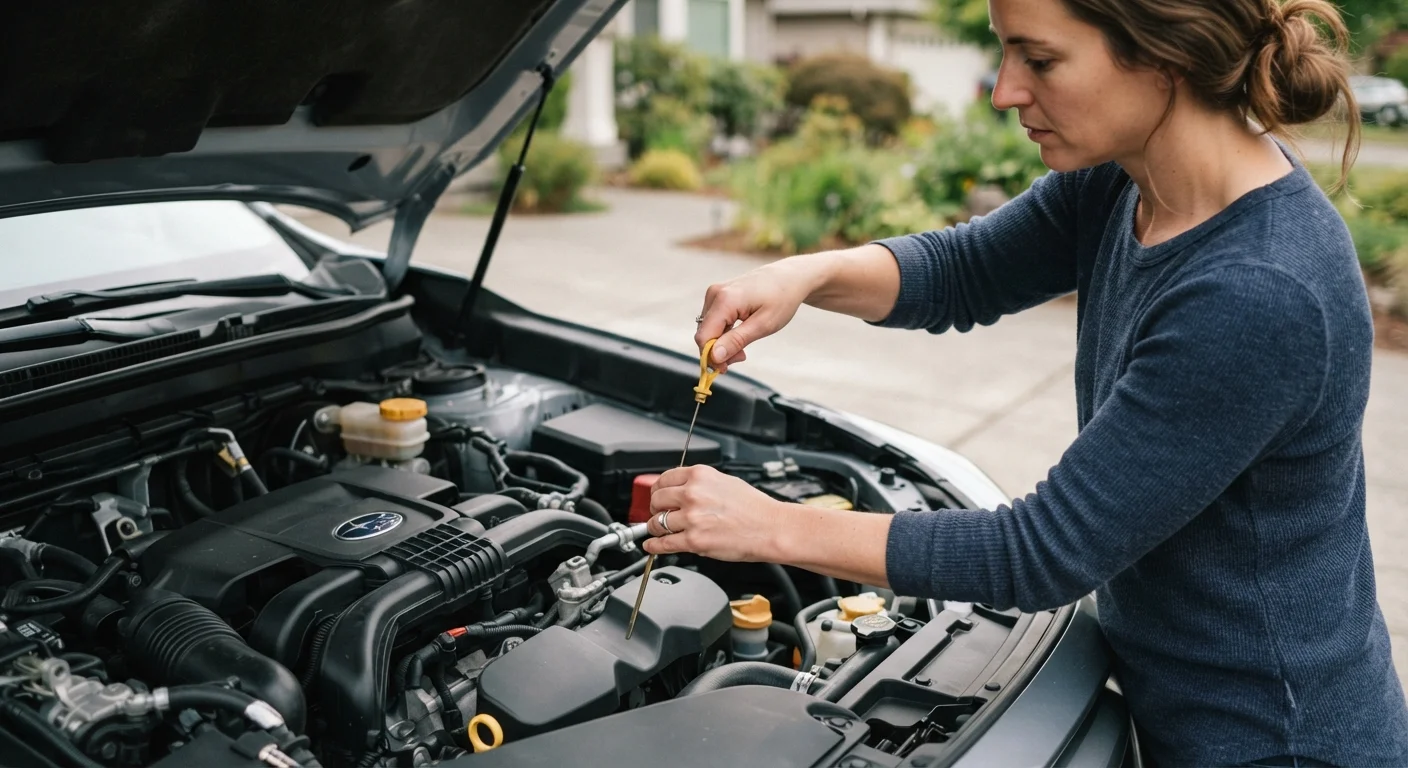
Check engine oil level and condition using the dipstick — oil should be between the min and max marks and appear amber, not black or gritty. Must
Inspect coolant (antifreeze) level in the overflow reservoir; the level should fall between the LOW and FULL lines when the engine is cold. Must
Check brake fluid level in the translucent reservoir under the hood; low levels can indicate worn brake pads or a slow leak. Must
Check power steering fluid level if your vehicle has a hydraulic system (many newer cars use electric power steering and have no reservoir). Should
Top off windshield washer fluid — the only fluid you can safely add without a mechanic, but easy to overlook until visibility matters most. Nice to have

Tires

Check tire pressure on all four tires (including the spare) using a gauge — inflate to the PSI listed on the driver's door jamb sticker, not the tire sidewall. Must
Inspect tread depth by placing a quarter upside down in the groove; if you can see the top of the head, tread is low and tires may need replacing. Must
Look for visible damage — bulges, cuts, embedded objects, or uneven wear patterns that could signal an alignment or suspension issue. Must
Rotate tires according to your owner's manual interval (typically every 5,000–7,500 miles) to promote even wear across all four. Should

Lights and Visibility

Test all exterior lights — headlights (low and high beam), taillights, brake lights, turn signals, and reverse lights — with a helper or by using a reflective surface. Must
Check that dashboard warning lights clear within a few seconds of starting the engine; persistent lights warrant investigation. Must
Inspect wiper blades for streaking, skipping, or torn rubber — replace if they leave smears across more than a small portion of the windshield. Should
Clean all exterior lights and mirrors to remove road film that reduces effectiveness, especially after wet or muddy conditions. Nice to have

Belts, Hoses, and Under-Hood Condition

Visually inspect the serpentine belt for cracks, fraying, glazing, or missing ribs — a snapped belt can disable the alternator, power steering, and water pump simultaneously. Must
Check visible coolant and other hoses for soft spots, cracks, swelling, or leaks at the connection clamps. Must
Look for any fluid puddles or stains under the car after it has sat overnight — oil, coolant, and transmission fluid all have distinct colors that can help identify the source. Must
Check the battery terminals for corrosion (white or blue-green buildup); clean with a wire brush if buildup is present, or have a shop test the battery's charge capacity. Should
Listen for any new noises — squealing, knocking, or rattling — when starting and during the first few minutes of driving, which can indicate developing issues. Should

Don't Ignore Dashboard Warning Lights

A warning light that stays on after startup is your car's way of flagging a system fault — not something to dismiss until the next oil change. The check engine light in particular can indicate anything from a loose gas cap to a misfiring engine. If a warning light appears or persists, consult our guide to check engine light causes and have the code read by a mechanic promptly.

Keeping these checks consistent is also one of the most straightforward ways to manage long-term ownership costs. See how drivers control vehicle costs over time for a broader look at the habits that keep repair bills manageable. For a full picture of monthly vehicle expenses, building a realistic monthly car budget offers a practical framework.

Automotive Editorial Team

InsightsBlock.com | Access Information With Ease

Automotive Editorial Team is the collective byline for our editorial team and contributor network. Articles published under this byline or an editorial pen name are researched, written, and reviewed according to our editorial standards for clarity, consistency, and independence before publication.

Car MaintenanceCar Ownership CostsDriver Safety
View author profile

The content provided on our blog site traverses numerous categories, offering readers valuable and practical information. Readers can use the editorial team’s research and data to gain more insights into their topics of interest. However, they are requested not to treat the articles as conclusive. The website team cannot be held responsible for differences in data or inaccuracies found across other platforms. Please also note that the site might also miss out on various schemes and offers available that the readers may find more beneficial than the ones we cover.