
Seat Belts vs. Airbags: How They Work Together-Not Independently

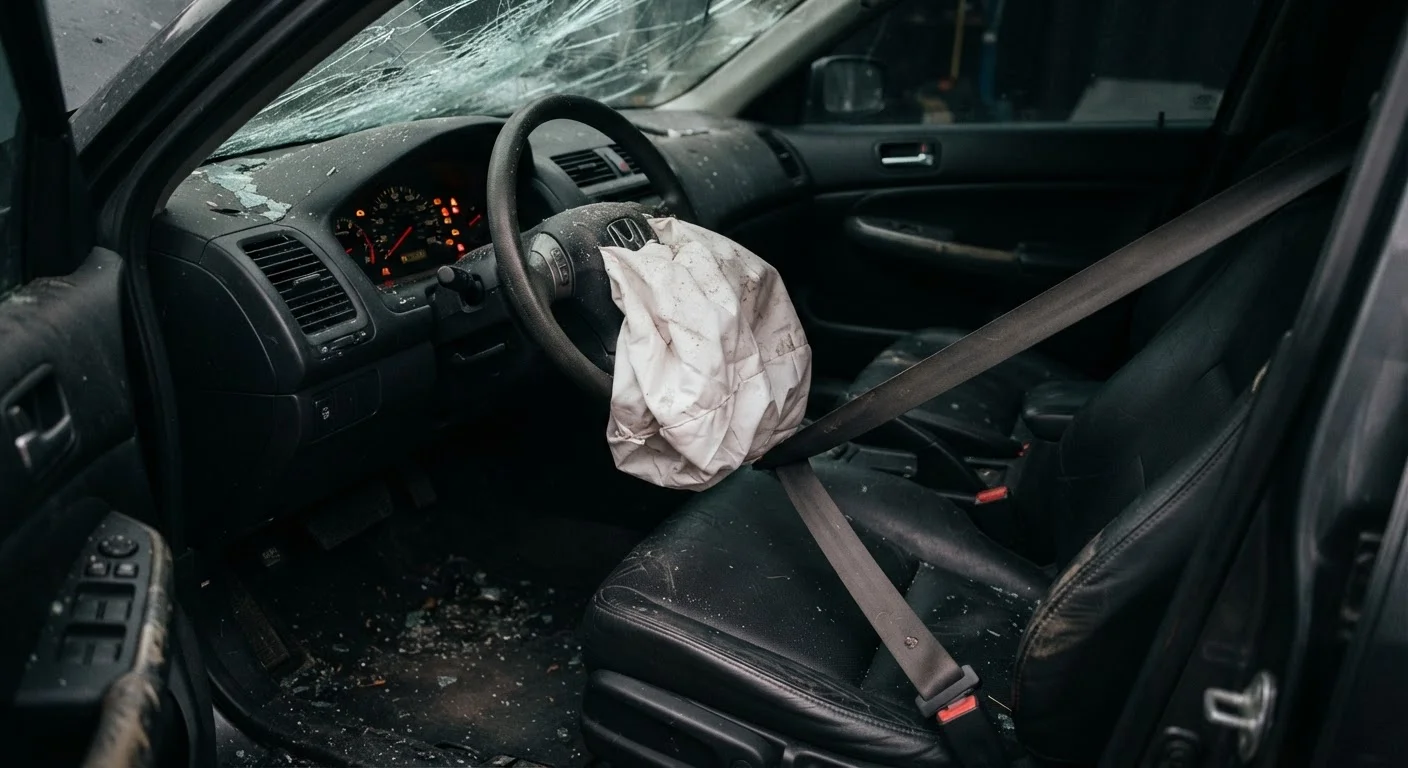
Photo: InsightsBlock.com | Access Information With Ease editorial
Key Takeaways
- Airbags are classified as Supplemental Restraint Systems (SRS) - they are designed to work with seat belts, not replace them.
- An unbelted occupant can be severely injured or killed by a deploying airbag, which inflates at speeds up to 200 mph.
- Seat belts alone reduce the risk of fatal injury in frontal crashes by roughly 45% for front-seat occupants.
- Airbags only deploy in specific crash scenarios; seat belts engage in every collision, including rollovers and rear impacts.
- Together, seat belts and airbags provide significantly greater protection than either system working alone.
Two Systems, One Purpose
A common misconception among drivers is that modern vehicles are so well-equipped with airbags that seat belts have become secondary. This misreading of how vehicle safety systems work can be dangerous. Airbags carry the formal designation Supplemental Restraint System (SRS) - a label that makes their role explicit. They supplement a seat belt; they do not replace it.
To understand why, consider what each system actually does during a crash. A seat belt immediately arrests your forward momentum the instant a collision begins, spreading deceleration force across the strongest parts of your body: the chest, hips, and shoulders. An airbag, by contrast, deploys in milliseconds to cushion a belted occupant's head and chest from striking hard interior surfaces. Without a belt holding the occupant back, that same airbag becomes a hazard - it strikes a person who is still moving forward at near-vehicle speed. For context on the physical forces at play, see what happens to your body during a car crash.
| Criterion | Seat Belts | Airbags |
|---|---|---|
| System classification | Primary restraint system | Supplemental Restraint System (SRS) |
| When it engages | Every collision and sudden stop | Only in qualifying crash types and severities |
| Effective without the other? | Yes - provides meaningful protection alone | No - dangerous to unbelted occupants |
| Coverage in rollovers | Yes - prevents ejection | Typically no deployment |
| Coverage in rear impacts | Yes - holds occupant in seat | Front airbags typically do not deploy |
| Primary protection area | Whole body - chest, hips, shoulders | Head and chest (frontal); torso/head (side) |
How Each System Engages - and When
Seat belts are passive and continuous. From the moment you click the buckle, the belt is doing its job. A pretensioner - present in most modern vehicles - tightens the belt automatically in the first milliseconds of a detected crash, pulling slack out of the webbing and pinning the occupant firmly into the seat before the airbag even deploys.
Airbags are threshold-triggered. Sensors in the vehicle detect the deceleration signature of a qualifying crash and fire the inflator only when the collision meets a certain severity and angle. Many real-world crashes - including low-speed rear impacts and rollovers - do not meet the deployment threshold for front airbags. In those events, the seat belt is the only active restraint. This is a critical detail: there is no single crash type in which a belt is unnecessary but an airbag fires.
~45%
Fatality reduction from seat belts alone
NHTSA data indicates seat belts reduce fatal injury risk for front-seat passenger car occupants by approximately 45% in crashes.
200 mph
Approximate airbag inflation speed
Front airbags can inflate at speeds approaching 200 mph, making proper belt positioning essential to avoid contact injuries.
50,000+
Lives saved by airbags (NHTSA estimate)
NHTSA estimates frontal airbags saved more than 50,000 lives between their introduction and the mid-2010s - predominantly among belted occupants.
Side curtain and torso airbags add meaningful protection in lateral collisions, but they too depend on the occupant being held in position by a belt. An unbelted occupant can slide under, over, or away from the bag's coverage zone entirely. The engineering of these systems is covered in detail in our look at vehicle safety features that changed how we think about crashes.
The Evidence for Using Both
Data from the National Highway Traffic Safety Administration (NHTSA) illustrates the difference clearly. Seat belts alone reduce the risk of fatal injury for front-seat occupants in passenger cars by approximately 45%. When a front airbag is added for a belted occupant, the fatality reduction in frontal crashes rises substantially beyond what the belt achieves alone. NHTSA estimates airbags have saved tens of thousands of lives since widespread adoption - but those figures apply almost entirely to belted occupants.
The inverse is also documented. In some crash configurations, an unbelted occupant close to a deploying airbag faces a higher injury risk than an unbelted occupant in the same crash without an airbag. Inflation forces are designed around the assumption that the occupant is held back by a belt and seated at an appropriate distance from the airbag module.
The takeaway is not complicated: the systems were co-designed. Skipping the belt does not neutralise the airbag - it turns a safety device into a potential hazard. Wearing the belt correctly, every time, is what allows the full restraint system to function as engineers intended.
This article provides general safety information for educational purposes. Always follow your vehicle manufacturer's guidelines and consult official road safety resources for guidance specific to your vehicle and jurisdiction.
The content provided on our blog site traverses numerous categories, offering readers valuable and practical information. Readers can use the editorial team’s research and data to gain more insights into their topics of interest. However, they are requested not to treat the articles as conclusive. The website team cannot be held responsible for differences in data or inaccuracies found across other platforms. Please also note that the site might also miss out on various schemes and offers available that the readers may find more beneficial than the ones we cover.