
What Happens to Your Body During a Car Crash

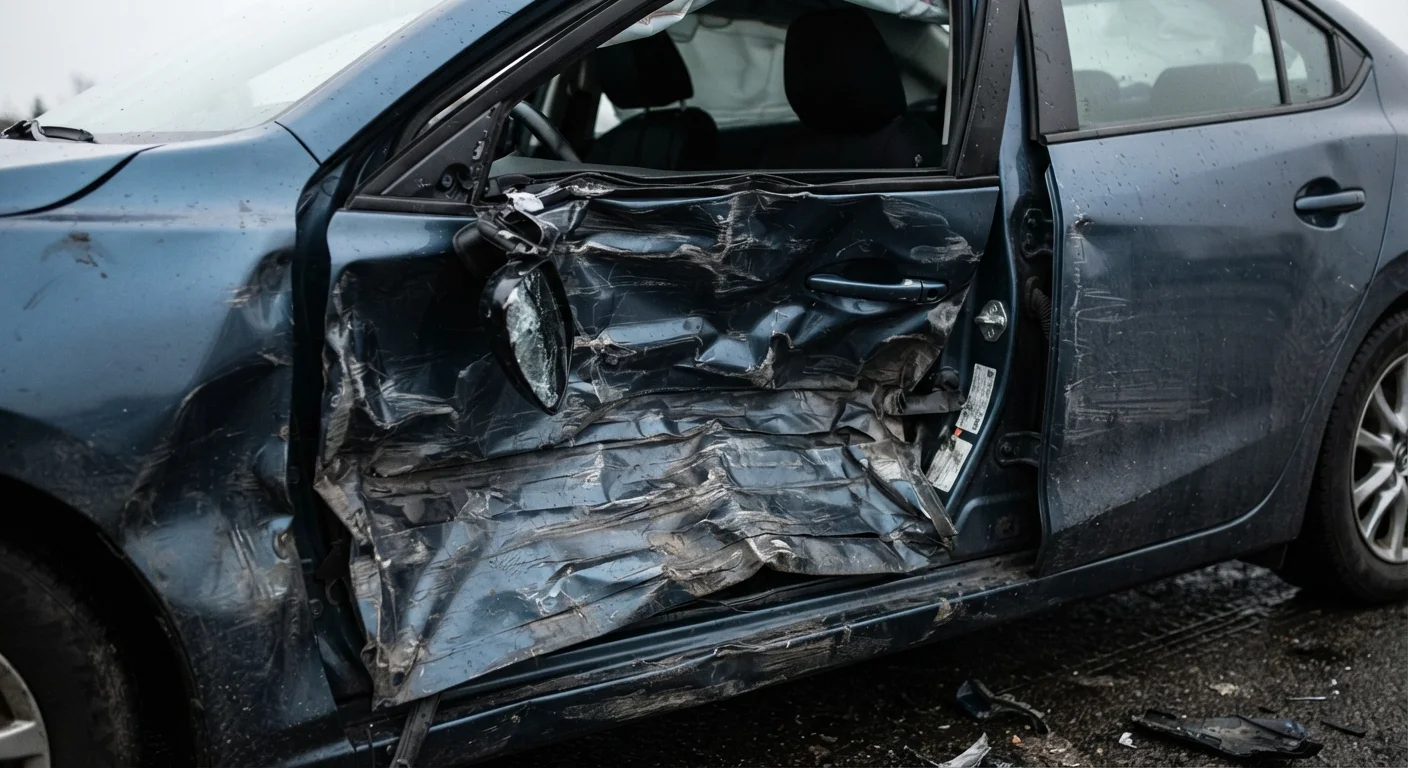
Photo: InsightsBlock.com | Access Information With Ease editorial
Key Takeaways
- Your body keeps moving at crash speed even after the vehicle stops - restraints arrest that motion.
- Three separate collisions occur in every crash: the vehicle, your body, and your internal organs.
- Unbelted occupants can hit the steering wheel or windshield at nearly the full pre-crash speed.
- Properly adjusted headrests are a critical factor in reducing whiplash-type neck injuries.
- Airbags are designed to work with seat belts, not replace them.
The Three Collisions Inside Every Crash
Traffic safety researchers describe every crash as involving three distinct collisions that happen in rapid sequence. Understanding each one explains why vehicle design and occupant behavior both matter enormously.
The first collision is the vehicle striking an object - another car, a barrier, or a tree. Modern vehicles are engineered with crumple zones that absorb energy progressively, slowing the car over a slightly longer time window to reduce peak force on occupants.
The second collision is your body striking something inside the vehicle. Because of inertia, your body keeps traveling at the pre-crash speed after the vehicle decelerates. A seat belt applies a broad restraining force across your sternum and pelvis, decelerating your body in concert with the car. Without one, your torso can slam into the steering wheel, your head into the windshield, or your knees into the dashboard.
The third collision is the one drivers rarely consider: your internal organs hitting the interior walls of your body. The heart, brain, liver, and other organs continue moving even after your torso stops. This explains why serious internal injuries - including traumatic brain injury, aortic tears, and organ lacerations - can occur even when no external wound is visible.
See our overview of engineering advances that shaped crash protection to understand how vehicle design addresses each of these collision stages.
How Forces Act on the Spine, Neck, and Head
The head and neck are among the most vulnerable areas in a collision because the head - weighing roughly 10-12 pounds - is supported by a relatively slender structure of vertebrae and soft tissue.
In a rear-end impact, the torso is pushed forward by the seat while the head, through inertia, lags behind. This causes hyperextension of the cervical spine. A properly positioned headrest interrupts this rearward motion before the neck reaches a damaging range of extension. If the headrest sits too low or is positioned several inches from the occupant's head, it provides little meaningful protection.
In a frontal crash, the belted occupant's torso is restrained while the head whips forward. Side curtain airbags and seatbelt pretensioners - which tighten automatically at the moment of impact - reduce how far the head travels before it is arrested.
Set Your Headrest Before Every Drive
Rotational or rollover crashes introduce additional angular forces. The brain is particularly susceptible to rotational acceleration, which can shear nerve fibers even when linear forces appear survivable. This is one reason why roll protection structures and side curtain airbags that stay inflated longer were significant engineering milestones.
Why Restraint Position Matters as Much as Restraint Use
Wearing a seat belt dramatically reduces fatality risk - the National Highway Traffic Safety Administration (NHTSA) has consistently found seat belts to be one of the most effective crash countermeasures available. But how a belt is worn matters nearly as much as wearing it at all.
A shoulder belt routed behind the back or tucked under the arm leaves the upper torso completely unrestrained during the second collision. A lap belt sitting across the abdomen rather than the hip bones can cause serious internal abdominal injury. These misuse patterns are more common than many drivers realize.
Airbag deployment - which occurs within roughly 30-50 milliseconds of a qualifying impact - requires the occupant to be seated correctly and at an appropriate distance from the steering wheel or dashboard. Drivers who sit with their sternum very close to the wheel, or who lean into the airbag zone, face greater injury risk from the bag itself at deployment. This is why automakers specify minimum seating distances and why children should never be seated in front of an active frontal airbag.
For a closer look at how these two systems are designed to complement each other, see how seat belts and airbags work together.
~45%
Reduction in front-seat fatality risk with seat belt use
NHTSA data consistently shows seat belts reduce the risk of death for front-seat passenger vehicle occupants by approximately 45%.
30 ms
Approximate airbag deployment time after impact
Most frontal airbag systems deploy within 30-50 milliseconds of a qualifying crash event, requiring belt restraint to position occupants correctly.
20-30 g
Deceleration force in a 30 mph frontal crash
Biomechanics research estimates that occupants may experience 20 to 30 times gravitational force during severe short-duration deceleration events.
What This Means for Everyday Driving Habits
Crash biomechanics research translates directly into habits that reduce injury risk before a crash ever happens.
- Adjust your headrest every time you drive. If multiple drivers share a vehicle, headrest position changes. The top of the restraint should align with the top of your ears at minimum.
- Check belt routing on every passenger, including children. A shoulder belt crossing a child's neck is a sign the child is too small for the seat position without a booster.
- Maintain proper seating distance from the steering wheel. Arms should reach the wheel comfortably without requiring you to lean forward - this keeps you within the designed airbag deployment envelope.
- Understand that inertia acts on cargo too. An unsecured object in the rear seat becomes a projectile in a sudden stop, capable of injuring rear and front occupants alike.
Distraction compounds these risks significantly. Research on distracted driving shows that cognitive distraction reduces the quality of hazard perception even when a driver's hands are on the wheel - meaning crash avoidance responses are delayed and the forces occupants ultimately experience are higher.
This article is for general informational and educational purposes only. For guidance specific to your vehicle, consult the owner's manual and a qualified safety professional.
Frequently Asked Questions
The content provided on our blog site traverses numerous categories, offering readers valuable and practical information. Readers can use the editorial team’s research and data to gain more insights into their topics of interest. However, they are requested not to treat the articles as conclusive. The website team cannot be held responsible for differences in data or inaccuracies found across other platforms. Please also note that the site might also miss out on various schemes and offers available that the readers may find more beneficial than the ones we cover.