
Choosing Between Community College and a Four-Year University

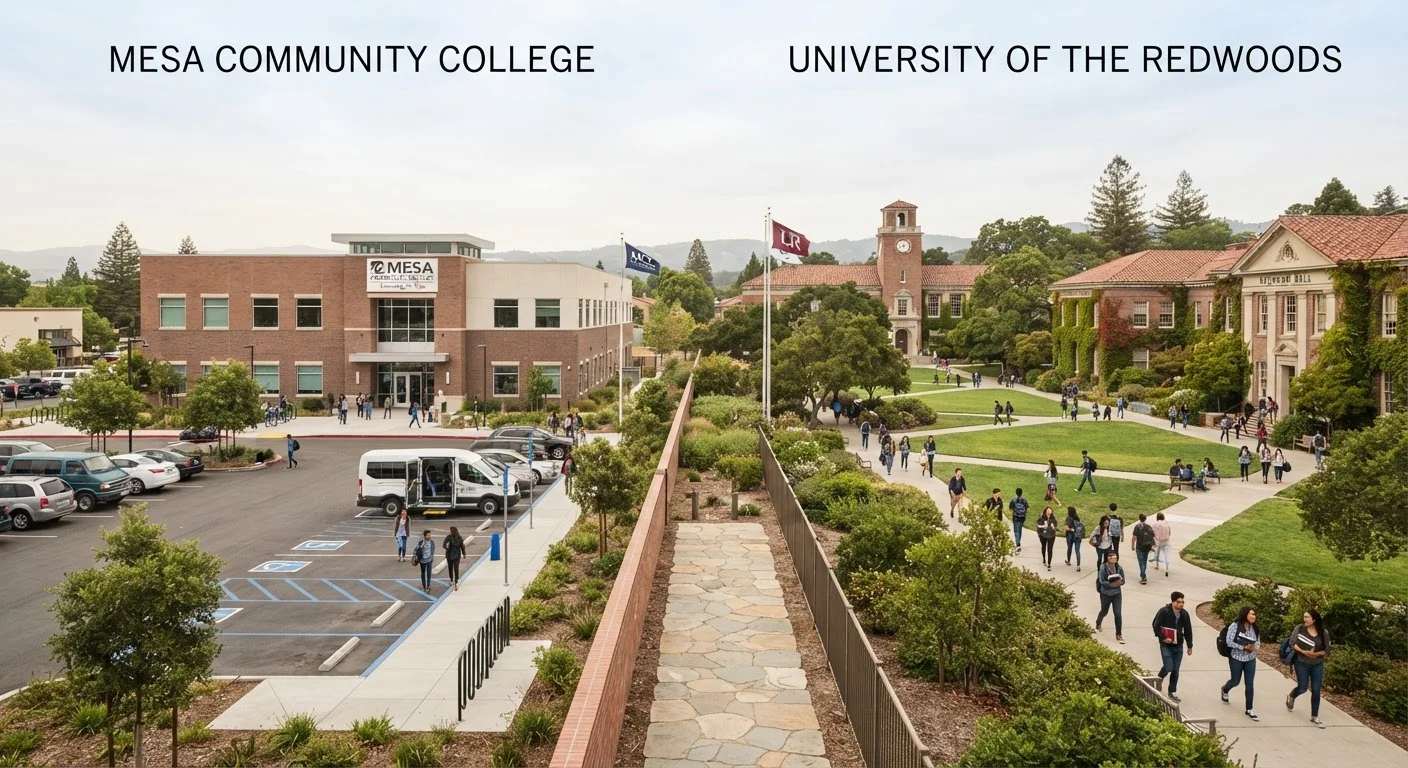
Photo: InsightsBlock.com | Access Information With Ease editorial
Key Takeaways
- Community colleges typically cost significantly less per credit hour than four-year universities.
- Articulation agreements can make transferring from a community college to a university a structured, predictable process.
- Four-year universities offer more on-campus resources, networking, and residential experiences.
- Neither option is inherently superior - the right fit depends on finances, goals, and personal circumstances.
- Employer and graduate school perceptions of credentials vary by field and institution type.
Significantly lower tuition and fees per credit
The average annual tuition at a public two-year college is roughly a fraction of what in-state students pay at a public four-year university, according to data published by the College Board. For students paying out of pocket or borrowing, this difference compounds over time.
Flexible scheduling for working students
Community colleges frequently offer evening, weekend, and hybrid courses designed around students who hold jobs or caregiving responsibilities. This flexibility can make degree completion realistic for adults who cannot attend full-time.
Structured transfer pathways to four-year schools
Many states maintain articulation agreements - formal arrangements that guarantee credit transfer when students move from a community college to a participating public university. When these agreements are followed carefully, students can complete general education requirements at lower cost before transferring.
Open or rolling admissions reduce access barriers
Most community colleges admit any student with a high school diploma or equivalent, removing the competitive admissions barrier that can discourage some prospective students from starting higher education at all.
Smaller class sizes in foundational courses
Introductory courses at large universities are sometimes taught in lecture halls with hundreds of students. Community college sections tend to be smaller, which can mean more direct access to instructors during critical early coursework.
Fewer on-campus resources and extracurriculars
Community colleges generally offer limited residential housing, fewer student clubs, and smaller career services departments compared to four-year institutions. Students who rely on campus life for networking or mentorship may find the environment less rich.
Transfer credit is not always guaranteed
Even with articulation agreements, individual departments at receiving universities sometimes reject specific credits or require students to repeat courses. Students should verify transfer policies with their intended major department - not just the admissions office.
Credential perception varies by employer and field
In some industries and graduate programs, the name on a bachelor's degree matters more than where general education credits were earned. This is not universal, but it is worth researching for specific career targets.
Completion rates are historically lower
National data consistently show that community college students complete degrees or transfer at lower rates than students who begin at four-year institutions. Contributing factors include financial pressure, part-time enrollment, and competing responsibilities - not academic ability.
How the Cost Difference Actually Works
Tuition is the most visible cost difference, but it is not the only one. Community college students often live at home, avoiding room and board expenses that can equal or exceed tuition at a four-year residential school. Students who complete two years at a community college before transferring can meaningfully reduce cumulative debt - provided they transfer credits efficiently.
The risk is taking longer than planned. Each additional semester extends both time and cost. Students should map out a credit plan before enrolling, confirm which courses will transfer, and set a realistic timeline. For a broader look at how institutional type affects price, see how public and private universities compare financially.
~$3,990
Average annual tuition at public two-year colleges
According to College Board's Trends in College Pricing data, the average published tuition and fees at public two-year colleges is substantially below that of four-year institutions.
~45%
Share of U.S. undergraduates enrolled at community colleges
The American Association of Community Colleges reports that community colleges serve a substantial portion of all undergraduate students in the United States.
~33%
Six-year completion or transfer rate at two-year colleges
National Center for Education Statistics data indicate that roughly one-third of students who begin at community colleges complete a credential or transfer within six years.
Advantages and Disadvantages at a Glance
Community colleges offer meaningful structural advantages - lower cost, open access, and scheduling flexibility - alongside real limitations in campus resources and variable transfer outcomes. The pros and cons below reflect general patterns across U.S. institutions; individual schools vary considerably.
Significantly lower tuition and fees per credit
The average annual tuition at a public two-year college is roughly a fraction of what in-state students pay at a public four-year university, according to data published by the College Board. For students paying out of pocket or borrowing, this difference compounds over time.
Flexible scheduling for working students
Community colleges frequently offer evening, weekend, and hybrid courses designed around students who hold jobs or caregiving responsibilities. This flexibility can make degree completion realistic for adults who cannot attend full-time.
Structured transfer pathways to four-year schools
Many states maintain articulation agreements - formal arrangements that guarantee credit transfer when students move from a community college to a participating public university. When these agreements are followed carefully, students can complete general education requirements at lower cost before transferring.
Open or rolling admissions reduce access barriers
Most community colleges admit any student with a high school diploma or equivalent, removing the competitive admissions barrier that can discourage some prospective students from starting higher education at all.
Smaller class sizes in foundational courses
Introductory courses at large universities are sometimes taught in lecture halls with hundreds of students. Community college sections tend to be smaller, which can mean more direct access to instructors during critical early coursework.
Fewer on-campus resources and extracurriculars
Community colleges generally offer limited residential housing, fewer student clubs, and smaller career services departments compared to four-year institutions. Students who rely on campus life for networking or mentorship may find the environment less rich.
Transfer credit is not always guaranteed
Even with articulation agreements, individual departments at receiving universities sometimes reject specific credits or require students to repeat courses. Students should verify transfer policies with their intended major department - not just the admissions office.
Credential perception varies by employer and field
In some industries and graduate programs, the name on a bachelor's degree matters more than where general education credits were earned. This is not universal, but it is worth researching for specific career targets.
Completion rates are historically lower
National data consistently show that community college students complete degrees or transfer at lower rates than students who begin at four-year institutions. Contributing factors include financial pressure, part-time enrollment, and competing responsibilities - not academic ability.
Transfer Pathways: What Students Often Overlook
Transfer is not automatic. Students who plan to transfer after two years should identify their target university and major before registering for their first community college semester. Taking courses that do not map to the receiving institution's requirements is one of the most common reasons transfer students lose credits - and time.
Articulation Agreements: Verify Before You Enroll
Families navigating these decisions sometimes focus too heavily on prestige and overlook practical fit questions. Common patterns that lead to poor college fits are worth reviewing before any enrollment decision is made.
Four-Year Universities: What the Higher Cost Buys
A four-year university typically offers a more integrated academic environment: research libraries, faculty office hours in specialized fields, career centers with employer partnerships, alumni networks, and residential communities that facilitate peer learning. For students entering fields where professional networks matter early - such as finance, engineering, or research - those on-campus connections can have practical value.
Students who know their intended career path and can manage costs responsibly may find the four-year experience worth its premium. Those still exploring their direction might find community college a lower-stakes environment in which to clarify goals before committing to a more expensive program. For students weighing non-traditional pathways, comparing online and in-person learning trade-offs may also be a useful frame of reference.
Making the Decision for Your Situation
There is no universally correct answer. Students with clear career goals in fields that credential heavily on institutional name may prioritize starting at a four-year school. Students who need to work, are supporting family members, or are uncertain about their direction may find community college reduces financial risk while keeping options open.
Whichever path a student begins, the habits that predict completion - consistent attendance, use of academic support services, connection with at least one advisor or mentor - matter more than the type of institution. Completion rates differ between institution types, but within any institution, engaged students outperform disengaged ones. For students considering further flexibility, an introduction to online education options covers how digital programs fit alongside or within traditional pathways.
This article provides general educational information and is not a substitute for personalized guidance from a school counselor, financial aid advisor, or college admissions professional.
The content provided on our blog site traverses numerous categories, offering readers valuable and practical information. Readers can use the editorial team’s research and data to gain more insights into their topics of interest. However, they are requested not to treat the articles as conclusive. The website team cannot be held responsible for differences in data or inaccuracies found across other platforms. Please also note that the site might also miss out on various schemes and offers available that the readers may find more beneficial than the ones we cover.