
Public University vs. Private College: Understanding the Real Differences

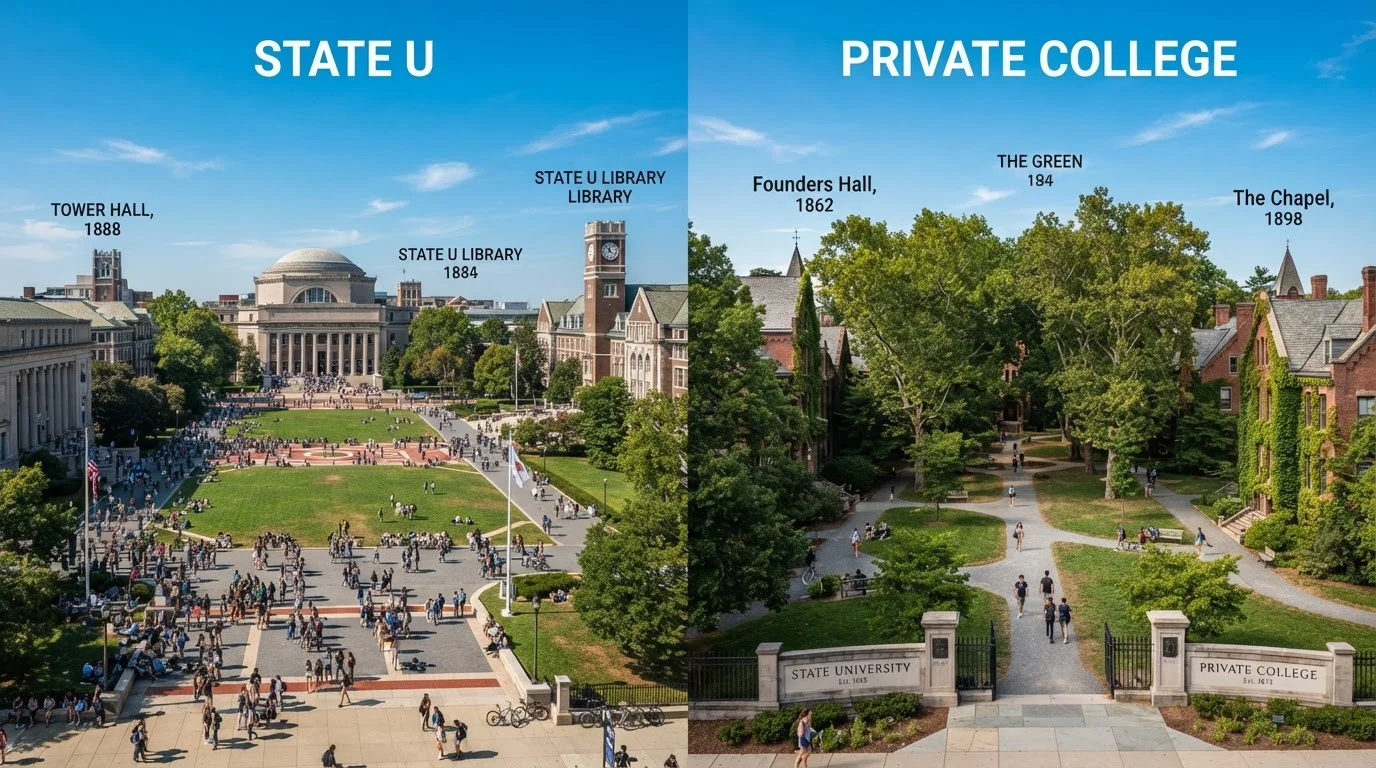
Photo: InsightsBlock.com | Access Information With Ease editorial
Key Takeaways
- Public universities typically charge lower in-state tuition than private colleges, but sticker prices don't tell the full story.
- Private colleges often award substantial institutional grant aid, which can reduce net cost significantly.
- Class sizes and student-to-faculty ratios tend to be smaller at private colleges, affecting day-to-day learning experiences.
- Public universities generally offer a wider range of majors, research facilities, and professional programs.
- Both institution types can lead to similar career outcomes; fit, financial aid, and program quality matter more than the label.
- Out-of-state students at public universities often pay tuition closer to private college rates.
Tuition and the Net Price Reality
The most-cited difference between public and private institutions is cost - but the raw tuition figure is rarely what students actually pay. Public universities charge two tuition rates: a lower in-state rate for residents and a higher out-of-state rate for everyone else. Private colleges charge a single rate regardless of residency, which is usually higher than in-state public tuition but sometimes lower than out-of-state public tuition.
What matters more than the sticker price is net price - tuition minus grants and scholarships the student receives. Private colleges, particularly those with large endowments, often award substantial institutional grant aid to admitted students. A private college with a $58,000 annual sticker price may cost a family with demonstrated financial need $22,000 or less after grants. Public universities, while starting lower, typically have smaller endowments and may offer less institutional aid per student.
The U.S. Department of Education's Net Price Calculator tool (available on every accredited institution's website under federal law) allows families to estimate actual costs before applying - a step every household should take before ruling out any institution on sticker price alone.
Always Compare Net Price, Not Sticker Price
Academic Environment: Size, Access, and Culture
Public universities enroll anywhere from 10,000 to over 60,000 undergraduates, which creates scale advantages - more majors, more research centers, more student organizations - but also means introductory courses can seat hundreds of students in lecture halls. Private colleges typically enroll fewer than 5,000 undergraduates, with many hovering between 1,500 and 3,000. That difference shows up daily: smaller sections, easier access to professors during office hours, and advising relationships that are more personal by structural design.
Neither model is inherently superior. Students who thrive with independence and enjoy navigating a large institution often find public universities energizing. Students who prefer discussion-based learning and consistent faculty mentorship may find private colleges a better fit. Visiting campus, sitting in on a class, and speaking with current students provides context that rankings cannot.
| Criterion | Public University | Private College |
|---|---|---|
| In-state tuition (typical range) | $10,000-$16,000/year | $40,000-$62,000/year (sticker) |
| Out-of-state tuition | $26,000-$45,000/year | Same as in-state |
| Average undergraduate enrollment | 15,000-60,000+ students | 1,500-5,000 students |
| Student-to-faculty ratio | Often 18:1 or higher | Often 10:1 or lower |
| Institutional grant aid | Moderate; smaller endowments | Often substantial; larger endowments |
| Program/major variety | Very broad; graduate programs common | Focused; fewer graduate programs |
| Research funding (federal) | High at R1 institutions | Variable; undergraduate-focused |
| Funding source | State government + tuition | Tuition + endowment + donations |
Financial Aid, Research, and Career Outcomes
Financial aid packages differ in composition. Public universities lean more heavily on federally funded aid - Pell Grants, subsidized loans, and work-study - while private colleges often layer substantial institutional grants on top of federal aid. This is why families are consistently advised to apply to a range of institution types and compare actual award letters rather than making assumptions based on institution category.
Research opportunities vary by institution mission. Large public research universities (often classified as R1 institutions by the Carnegie Classification system) receive significant federal research funding and may offer undergraduates lab access and faculty research partnerships early in their studies. Many private liberal arts colleges also emphasize undergraduate research but at a smaller scale and with closer faculty supervision.
Career outcomes - employment rates, earnings, graduate school acceptance - are influenced less by public vs. private status than by program quality, field of study, internship access, and individual effort. Studies consistently show that student engagement and institutional fit are stronger predictors of post-graduation success than institution type alone. For students weighing alternatives like fully online programs, our comparison of online and in-person education covers those trade-offs honestly. Families also comparing two-year starting points will find our community college versus four-year university guide a useful companion read.
This article provides general educational information and is not a substitute for personalized guidance from a certified college counselor or financial aid professional. Aid amounts, tuition rates, and program offerings change regularly - always verify details directly with institutions.
The content provided on our blog site traverses numerous categories, offering readers valuable and practical information. Readers can use the editorial team’s research and data to gain more insights into their topics of interest. However, they are requested not to treat the articles as conclusive. The website team cannot be held responsible for differences in data or inaccuracies found across other platforms. Please also note that the site might also miss out on various schemes and offers available that the readers may find more beneficial than the ones we cover.