
Wet Food, Dry Food, or Both: Understanding Cat Feeding Options

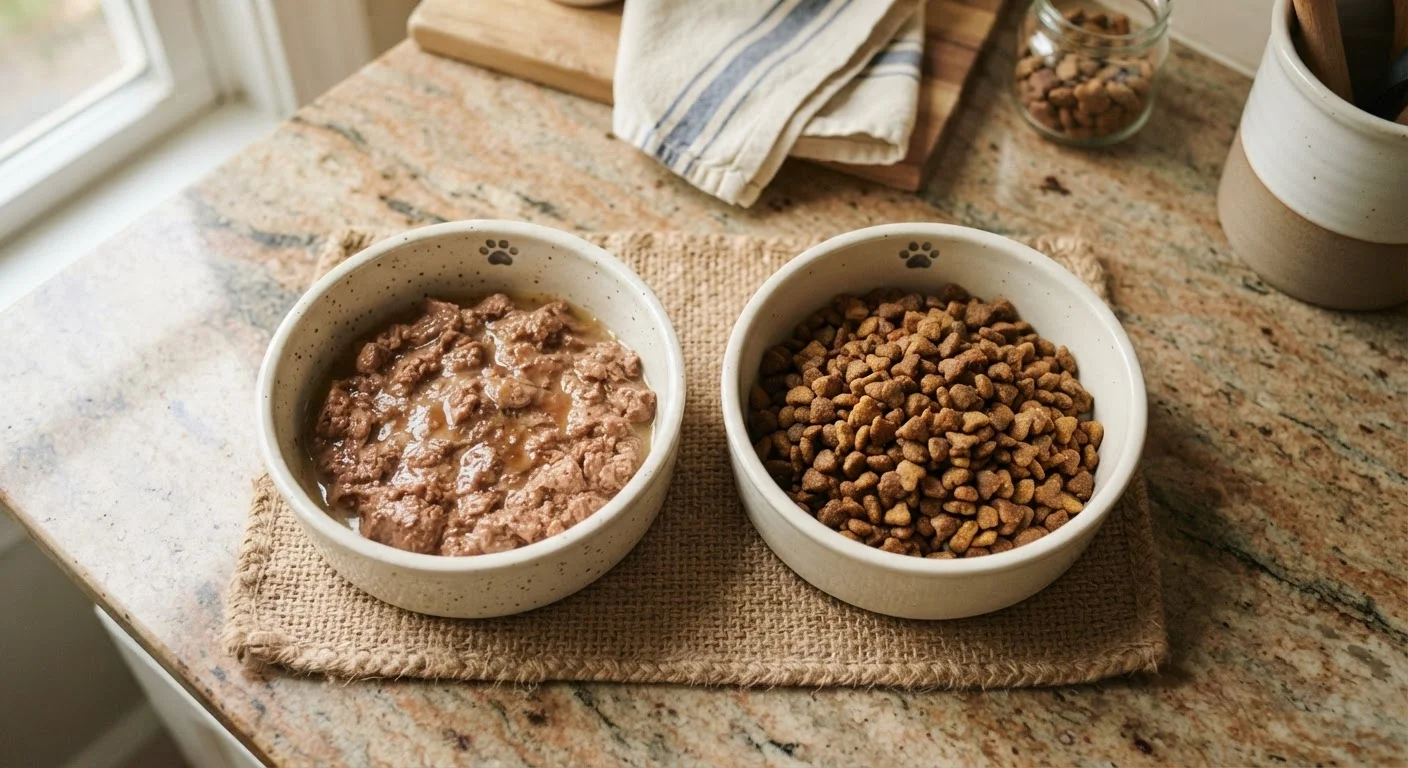
Photo: InsightsBlock.com | Access Information With Ease editorial
Key Takeaways
- Wet food contains roughly 70-80% moisture, significantly boosting a cat's daily water intake.
- Dry kibble is more calorie-dense per ounce and generally costs less per day to feed.
- Cats with urinary tract issues or chronic kidney disease often benefit from the added moisture in wet food.
- A combination approach - mixing both formats - can balance hydration, palatability, and cost.
- Always check that any food carries an AAFCO nutritional adequacy statement appropriate to your cat's life stage.
- Consult your veterinarian before making significant diet changes, especially for cats with health conditions.
How Wet and Dry Cat Food Differ at a Glance
The most immediate difference between wet and dry cat food is water content. Wet food - whether pâté, shreds, or chunks in gravy - typically contains 70-80% moisture. Dry kibble, by contrast, contains only about 8-12% moisture. For cats, who evolved as desert hunters and naturally have a low thirst drive, this distinction carries real health implications.
Beyond moisture, the two formats differ in caloric density, ingredient composition, shelf life, and cost. Understanding each dimension helps you make a choice that fits both your cat's physiology and your daily routine. For a deeper look at how to interpret the labels on either type, see our guide to reading cat food labels.
| Criterion | Wet Cat Food | Dry Cat Food (Kibble) |
|---|---|---|
| Moisture content | 70-80% | 8-12% |
| Hydration support | High - significant daily contribution | Low - relies on separate water intake |
| Caloric density (per oz) | Lower - larger portions needed | Higher - smaller portions needed |
| Typical daily cost | Higher | Lower |
| Shelf life (opened) | 24-48 hours refrigerated | Weeks at room temperature |
| Palatability | Generally higher - strong aroma | Varies; some cats prefer texture |
| Carbohydrate content | Generally lower | Generally higher |
| Suitability for free-feeding | Not recommended - spoils quickly | Practical for all-day access |
The Hydration Case for Wet Food
Domestic cats often drink less water than they need, a pattern inherited from ancestors who obtained most of their moisture from prey. Chronic mild dehydration is associated with urinary tract problems and can put additional strain on the kidneys over time. Wet food can meaningfully close that gap - a cat eating wet food exclusively may consume two to three times more total water per day than one eating only kibble.
This is why many veterinarians recommend wet food - or a combination diet - for cats diagnosed with chronic kidney disease (CKD), feline idiopathic cystitis (FIC), or a history of urinary crystals. It is important to note, however, that diet alone is not a treatment for these conditions. Always work with your veterinarian to determine the right dietary approach for a cat with an existing health diagnosis.
70-80%
Moisture in typical wet cat food
Compared to roughly 8-12% in dry kibble, wet food can dramatically increase a cat's total daily water consumption.
2-3×
More water consumed on a wet food diet
Veterinary nutrition references note that cats eating wet food often consume two to three times more total water daily than those eating exclusively dry kibble.
~60%
Protein of natural prey (mouse, by dry matter)
Wild prey runs roughly 55-65% protein on a dry-matter basis - a benchmark wet food formulas tend to approximate more closely than most kibbles.
Cost, Convenience, and Practical Feeding
On a per-day basis, dry kibble is almost always less expensive than wet food. A cat's daily wet food requirement - typically around 3-4 oz cans or pouches per day depending on size and caloric density - can cost significantly more than an equivalent caloric portion of kibble. For multi-cat households, this gap becomes even more noticeable over a month.
Kibble also wins on convenience: it is shelf-stable for months, easy to measure, and safe to leave in a bowl for several hours without spoiling. Opened wet food, by contrast, must be refrigerated and used within 24-48 hours. Free-feeding (leaving food out all day) is only practical with dry food, though it can contribute to overeating in some cats - structured mealtimes help with portion control regardless of format.
Many owners settle on a combination approach: a measured portion of wet food at one or two set mealtimes, supplemented with a controlled amount of dry kibble. This balances hydration support with cost efficiency, and can also enrich the feeding experience for cats who enjoy variety.
Nutritional Quality: What Both Formats Can and Cannot Guarantee
Wet and dry cat foods can both be nutritionally complete - but that status depends entirely on the specific product, not the format. In the United States, the AAFCO sets nutrient profiles for cat food. Look for a statement on the label confirming the food is "complete and balanced" for your cat's life stage (kitten, adult, or all life stages).
Dry food tends to be higher in carbohydrates than wet food, which is worth noting given that cats are obligate carnivores with limited ability to use carbohydrates as a primary energy source. That said, a well-formulated kibble can still meet all of a cat's nutritional needs. Wet food formulas more closely mirror the macronutrient profile of a cat's natural prey - higher in protein and fat, lower in carbohydrates - though quality varies widely between products.
If you are curious how commercial diets compare to other feeding philosophies, our article on raw diets vs. commercial cat food reviews what current research says about each approach.
This article provides general pet care information and is not a substitute for professional veterinary advice. Always consult your veterinarian for guidance specific to your cat's health needs.
The content provided on our blog site traverses numerous categories, offering readers valuable and practical information. Readers can use the editorial team’s research and data to gain more insights into their topics of interest. However, they are requested not to treat the articles as conclusive. The website team cannot be held responsible for differences in data or inaccuracies found across other platforms. Please also note that the site might also miss out on various schemes and offers available that the readers may find more beneficial than the ones we cover.