
Reading a Cat Food Label: What the Ingredients Actually Mean

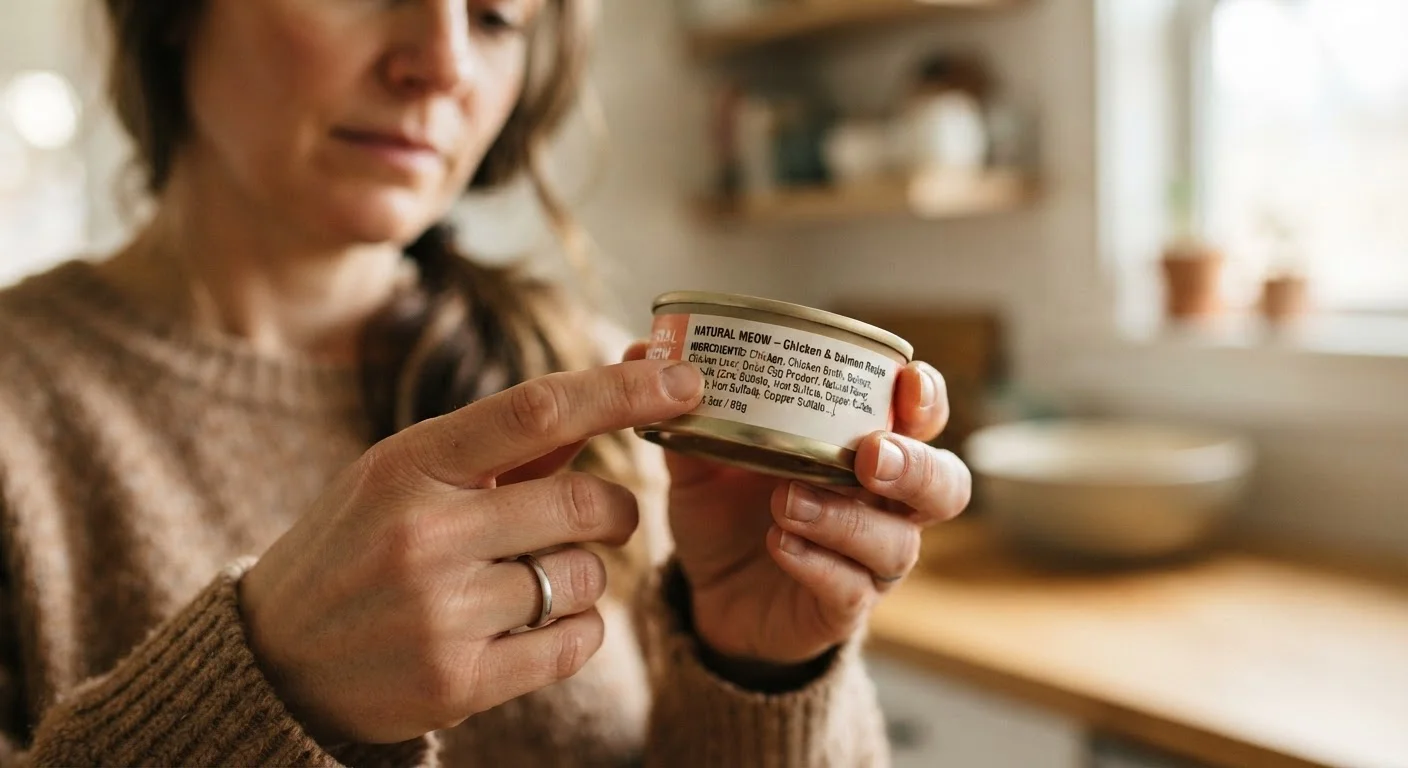
Photo: InsightsBlock.com | Access Information With Ease editorial
Key Takeaways
- Ingredients are listed by pre-cooking weight, so moisture content affects protein ranking.
- The guaranteed analysis panel shows minimum or maximum nutrient levels, not exact amounts.
- An AAFCO nutritional adequacy statement confirms whether a food is complete and balanced.
- Named protein sources like 'chicken' are more specific than vague terms like 'meat by-products'.
- By-products are not inherently inferior - organ meats are nutrient-dense animal components.
- Cats are obligate carnivores, making high animal-protein content the most critical label signal.
Why Cat Food Labels Are Worth Decoding
Cat food labels follow a regulated structure in the US, governed largely by AAFCO model regulations adopted at the state level. Every section of the label - product name, ingredient list, guaranteed analysis, and adequacy statement - carries specific legal meaning. Reading them correctly gives you a more accurate picture of what your cat is eating than marketing claims on the front of the package ever will.
Cats are obligate carnivores, which means their bodies require nutrients found primarily in animal tissue - including taurine, arachidonic acid, and preformed vitamin A - that other species can synthesize from plant precursors. Understanding how to read a label helps you verify that a food actually delivers the animal-based nutrition your cat depends on. For a broader view of how these choices play out in practice, our guide to wet vs. dry food walks through the practical differences between formats.
What you will need
This article provides general nutritional education and is not a substitute for veterinary advice. Always consult your veterinarian before making significant changes to your cat's diet, especially for cats with health conditions.
How to Read Every Section of the Label
Work through the label systematically using the steps below. Each section builds on the last - the product name sets expectations, the ingredient list reveals composition, the guaranteed analysis quantifies key nutrients, and the AAFCO statement confirms whether the food is nutritionally complete.
Find and read the product name carefully
The product name is more informative than it looks. Regulatory guidelines - largely aligned with AAFCO standards - govern how ingredient names may appear:
- "Chicken Cat Food" (no qualifier): the named ingredient must make up at least 95% of the total product weight, excluding water.
- "Chicken Dinner" / "Chicken Entrée": the named ingredient must comprise at least 25% of the product.
- "With Chicken": only 3% of the product needs to be that ingredient.
- "Chicken Flavor": no minimum quantity - just enough to be detectable.
A product called "Salmon and Tuna Dinner" must contain both, with the first-listed ingredient present in the larger proportion.
Read the ingredient list from top to bottom
Ingredients are listed in descending order by weight before cooking. Because fresh meats contain a high percentage of water, a fresh chicken listed first may weigh less than a dry ingredient like corn gluten meal after processing. This is called the moisture dilution effect.
Look for:
- Named protein sources: "chicken," "salmon," or "turkey" rather than generic "meat" or "animal protein."
- Whole vs. meal: "Chicken meal" is dehydrated chicken with moisture removed - it delivers a concentrated source of protein and is not inferior to fresh chicken on a dry-matter basis.
- By-products: "Chicken by-product meal" includes organs, necks, and other non-muscle parts. These are nutritious; they are not the same as feathers, hooves, or filler.
- Carbohydrate fillers: Cats have a limited physiological need for carbohydrates. Ingredients like corn, wheat, or potato in the first few positions may indicate a lower protein-to-carb ratio.
Interpret the guaranteed analysis panel
The guaranteed analysis (GA) appears as a small table or list and is required on every label. It shows four core nutrients at minimum:
| Nutrient | What the label shows |
|---|---|
| Crude Protein | Minimum percentage |
| Crude Fat | Minimum percentage |
| Crude Fiber | Maximum percentage |
| Moisture | Maximum percentage |
These are guaranteed values - legal minimums or maximums - not precise measurements. The actual content can vary. Because wet and dry foods differ vastly in moisture content, comparing them directly on an as-fed basis is misleading. To compare accurately, convert both to a dry-matter basis by dividing the as-fed nutrient percentage by (100 minus the moisture percentage), then multiplying by 100.
Locate the AAFCO nutritional adequacy statement
This statement - sometimes called the 'nutritional adequacy statement' or 'complete and balanced' claim - is one of the most important lines on the label. It will say one of the following:
- "Formulated to meet the nutritional levels established by AAFCO…" - the recipe was calculated against a nutrient profile but may not have been fed to actual animals.
- "Animal feeding tests using AAFCO procedures substantiate that [product] provides complete and balanced nutrition…" - the food passed a live animal feeding trial, a higher evidence standard.
- "This product is intended for intermittent or supplemental feeding only" - this food is not complete and balanced and should not be a cat's sole diet.
Also check the life stage: "all life stages," "adult maintenance," or "growth and reproduction" tells you whether the food was formulated for kittens, adults, or seniors. A food labeled for all life stages meets the higher kitten requirements.
Check for additives, preservatives, and supplements
The end of the ingredient list typically contains:
- Vitamins and minerals: Long chemical names like 'zinc proteinate' or 'pyridoxine hydrochloride' are legitimate nutritional supplements, not warning signs.
- Preservatives: Natural preservatives include mixed tocopherols (vitamin E) and rosemary extract. Synthetic options like BHA and BHT are approved for use at regulated levels, though some owners prefer to avoid them.
- Colorants and flavor enhancers: These benefit the owner's perception more than the cat's. Cats have far fewer taste receptors than humans and cannot detect sweetness at all.
Taurine - an amino acid cats cannot synthesize adequately on their own - should appear in the ingredient list or be reflected in an added taurine claim. Its absence from the label is a potential concern worth discussing with your veterinarian.
Use Dry-Matter Basis for Honest Comparisons
For a side-by-side look at how these same principles apply to dog food, see what dog food labels actually mean. The structure is similar, but cats have distinct nutritional requirements that change how you prioritize what you find.
If you are weighing whole commercial diets against alternative approaches, our overview of raw vs. commercial cat food summarizes what current research and veterinary guidance indicate.
Common Label Claims and What They Actually Mean
Front-of-package marketing language is not regulated the same way as the mandatory label sections. Here is how to interpret the most common phrases:
- "Natural": AAFCO defines this as derived from plant, animal, or mined sources without chemical synthesis. It does not mean organic, additive-free, or superior in nutrition.
- "Grain-free": Grains are replaced by other carbohydrate sources such as peas, lentils, or potatoes. Grain-free does not mean low-carb or higher protein by default. Check the ingredient list and guaranteed analysis to verify protein content.
- "Human-grade": No official AAFCO definition exists for this term as applied to finished pet food, though some manufacturers use it. Verify claims by looking at the ingredient composition rather than relying on this label.
- "Limited ingredient": Suggests a shorter ingredient list, which may benefit cats with confirmed food sensitivities. Confirm with your veterinarian before switching to a limited-ingredient diet for allergy management.
Marketing Claims Are Not Nutritional Evidence
If you are new to reading nutritional panels more broadly, our guide to reading nutrition facts labels covers the underlying concepts in plain language.
The content provided on our blog site traverses numerous categories, offering readers valuable and practical information. Readers can use the editorial team’s research and data to gain more insights into their topics of interest. However, they are requested not to treat the articles as conclusive. The website team cannot be held responsible for differences in data or inaccuracies found across other platforms. Please also note that the site might also miss out on various schemes and offers available that the readers may find more beneficial than the ones we cover.