
Tire Rotation, Balancing, and Alignment: Why Each Is a Different Job

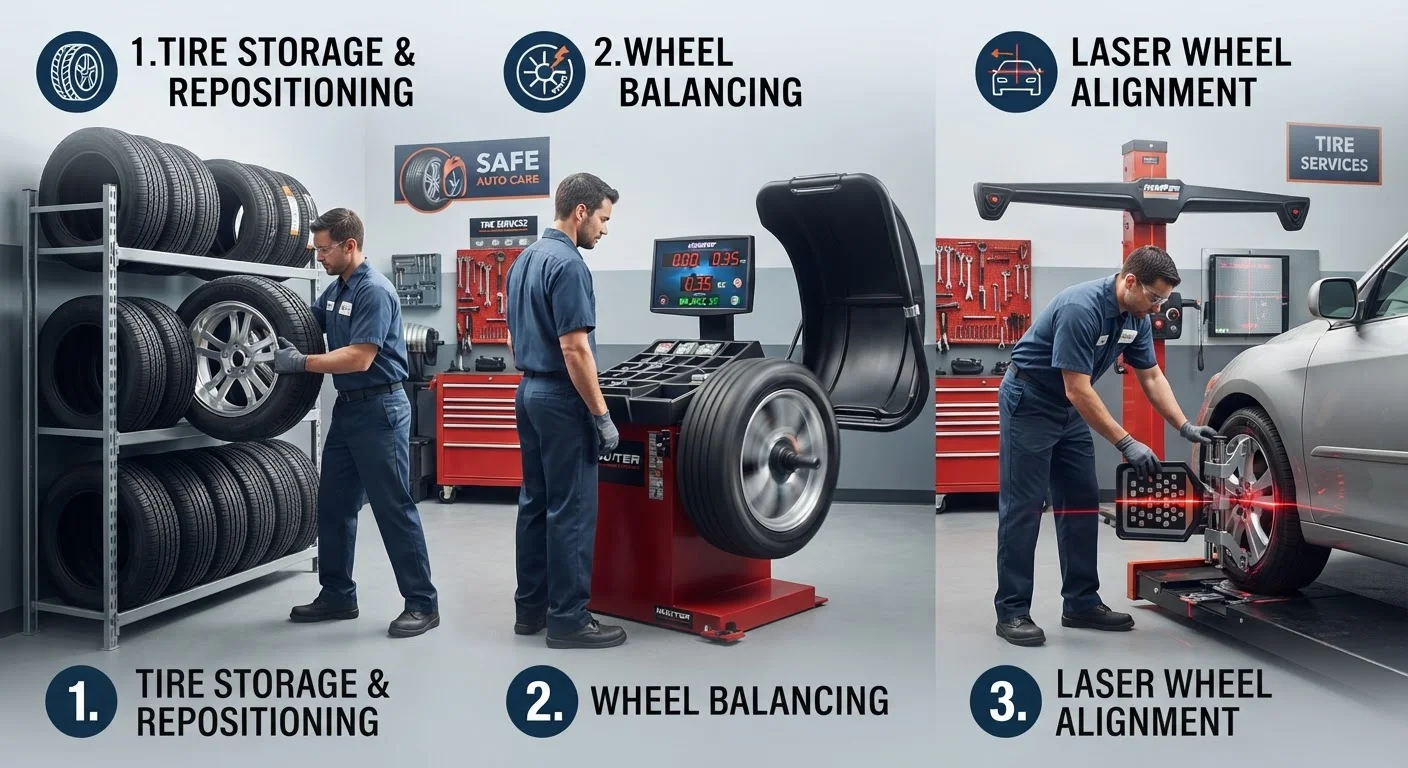
Photo: InsightsBlock.com | Access Information With Ease editorial
Key Takeaways
- Rotation, balancing, and alignment solve different problems and are not interchangeable.
- Rotation is typically recommended every 5,000-7,500 miles to even out tread wear across all four tires.
- Balancing corrects vibrations caused by uneven weight in a wheel-and-tire assembly.
- Alignment adjusts suspension angles so tires contact the road correctly, preventing uneven wear and pulling.
- Skipping any one of these services can lead to premature tire replacement and higher long-term costs.
- Your owner's manual is the most reliable source for service intervals specific to your vehicle.
Tire Rotation: Equalizing Wear Across All Four Corners
Your tires do not wear evenly. On a front-wheel-drive vehicle, the front tires handle steering, braking, and power delivery simultaneously - a demanding combination that accelerates their wear relative to the rear. On rear-wheel-drive vehicles, the dynamic reverses. Even all-wheel-drive systems distribute forces unevenly depending on terrain and driving style.
Rotation moves each tire to a different wheel position on a regular schedule so that no single tire bears a disproportionate workload. A front-left tire might move to the rear-right, for example, depending on the rotation pattern your vehicle and tire type call for. Over time, this strategy helps all four tires wear at a similar rate, extending the life of the full set.
Most manufacturers suggest rotating tires every 5,000-7,500 miles, and many drivers pair it with an oil change for convenience. The exact interval for your vehicle is spelled out in your owner's manual - see our guide to reading your maintenance schedule for help interpreting it. Skipping rotations doesn't produce an immediate symptom, which is why it's easy to overlook - but the cost of replacing a set of tires prematurely makes the case for staying on schedule.
Pair Rotation with Oil Changes for Consistency
Wheel Balancing: Smoothing Out Hidden Weight Imbalances
When a tire is mounted on a wheel, the combined assembly is rarely perfectly uniform in weight. Minor variations in rubber density, the valve stem, and even small manufacturing tolerances create slight imbalances. At low speeds these are imperceptible. At highway speeds, they translate into a rhythmic vibration felt through the steering wheel, floorboard, or seat.
Balancing corrects this by spinning the wheel-and-tire assembly on a dedicated machine that identifies where weight is unevenly distributed. A technician then attaches small counterweights to the rim at precise points to bring the assembly into balance.
~$10-$15
Typical cost per tire for balancing
Industry estimates from automotive service organizations suggest wheel balancing generally costs between $10 and $15 per tire, though prices vary by region and shop.
Up to 45%
Reduction in tire life from misalignment
Automotive research has indicated that significant toe misalignment alone can reduce usable tire tread life by as much as 45%, depending on the degree of misalignment.
5,000-7,500 mi
Common tire rotation interval
Most major tire manufacturers and vehicle OEMs recommend rotation within this mileage range, though your owner's manual should always be the primary reference.
Tires typically need rebalancing when new tires are mounted, when you notice vibration at highway speeds, or if a wheel weight has fallen off. Many shops recommend checking balance every 12,000-15,000 miles as a precaution, though symptoms are often the clearest indicator that service is needed.
It's worth noting that balancing and rotation are often performed together - but they are mechanically separate tasks. A rotation moves tires to new positions; balancing ensures each wheel-and-tire combination spins without vibration. Both can be done in a single shop visit, but one does not substitute for the other.
Wheel Alignment: A Suspension Geometry Adjustment
Alignment is the most technically distinct of the three services. It has nothing to do with moving tires or balancing weight - it's an adjustment to the angles of your vehicle's suspension system, which determines how the tires meet the road.
Three primary angles are measured and adjusted: camber (the vertical tilt of the tire viewed from the front), toe (whether tires point inward or outward when viewed from above), and caster (the steering axis angle viewed from the side). When any of these fall outside the manufacturer's specifications, tires scrub the road abnormally, causing uneven wear, steering drift, and reduced fuel efficiency.
Alignment requires a specialized rack and laser measurement system. It cannot be assessed by visual inspection alone, and it's not a task appropriate for DIY - see our breakdown of when to handle maintenance yourself versus going to a shop for more context on where the line falls.
Common triggers for an alignment check include hitting a significant pothole or curb, the vehicle pulling to one side on a flat road, or a steering wheel that sits noticeably off-center when driving straight. Many manufacturers suggest checking alignment annually or every 12,000-15,000 miles, though your manual may specify differently. For a broader look at how these services fit into your overall ownership costs, the routine maintenance cost reference is a useful resource.
Alignment Specs Are Vehicle-Specific
Why Knowing the Difference Saves You Money
Misunderstanding these services creates real financial risk. A driver who gets a rotation when they actually needed alignment may continue wearing through tires unevenly without realizing it. Similarly, ignoring vibration caused by an out-of-balance wheel puts stress on wheel bearings and suspension components over time - turning a minor service into a more expensive repair.
These services are not redundant; they work together. Well-aligned tires wear more evenly, so rotation maintains a uniform wear pattern that already exists. Balanced tires reduce stress on the vehicle's suspension components. All three together form a coherent strategy for extending tire life and preserving driver safety on the road.
For a broader look at which maintenance habits genuinely protect your vehicle - and which are based on outdated assumptions - our car maintenance myths guide covers common misunderstandings that cost drivers money every year.
Frequently Asked Questions
The content provided on our blog site traverses numerous categories, offering readers valuable and practical information. Readers can use the editorial team’s research and data to gain more insights into their topics of interest. However, they are requested not to treat the articles as conclusive. The website team cannot be held responsible for differences in data or inaccuracies found across other platforms. Please also note that the site might also miss out on various schemes and offers available that the readers may find more beneficial than the ones we cover.