
How Debt Consolidation Works and When It Makes Sense

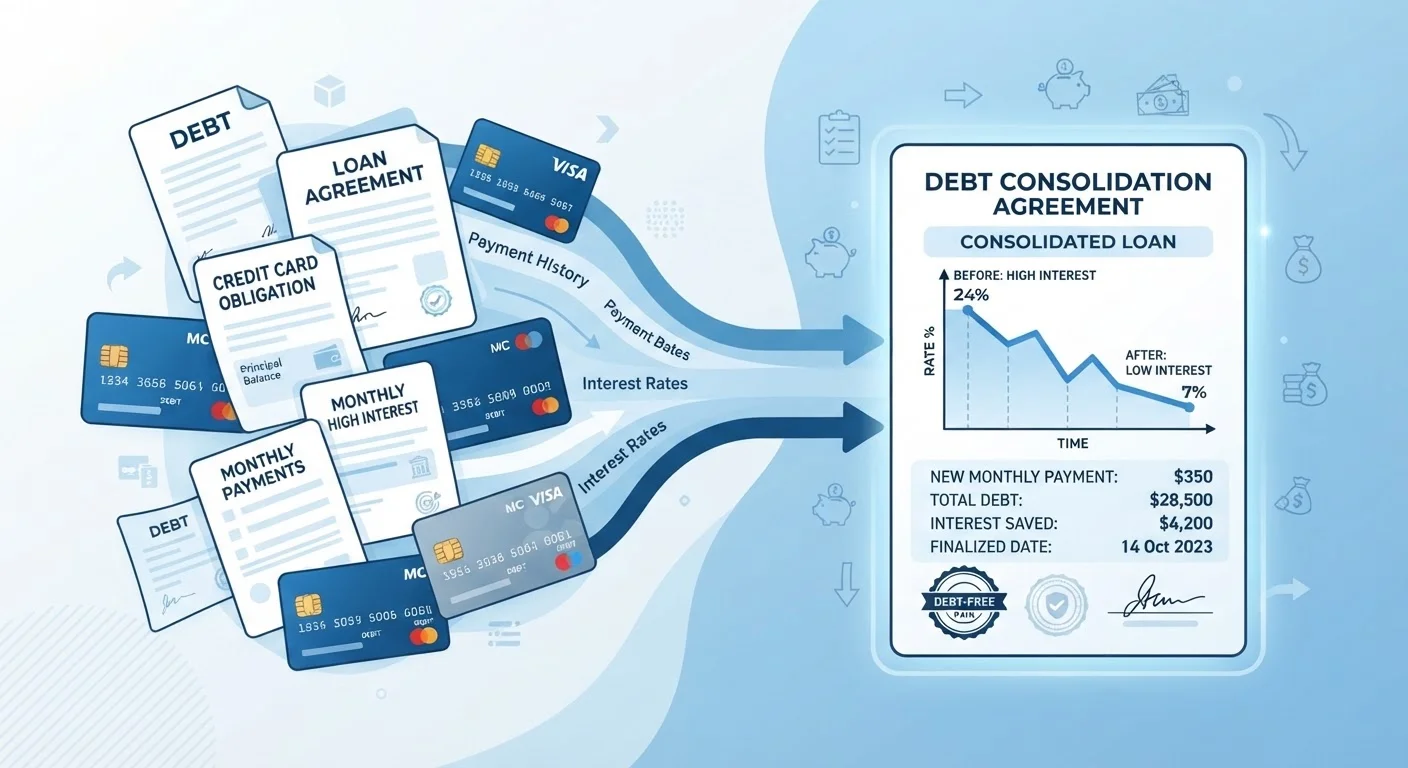
Photo: InsightsBlock.com | Access Information With Ease editorial
Key Takeaways
- Debt consolidation rolls multiple debts into a single loan or payment, often with one interest rate.
- It can lower your monthly payment or total interest cost, but not always both at once.
- Your credit score and debt type significantly affect whether consolidation will save you money.
- Consolidation does not eliminate debt - it restructures it, and new spending habits matter.
- Always compare the total cost over the loan's full term, not just the monthly payment.
Single monthly payment reduces administrative complexity
Managing one due date instead of five or six reduces the chance of missed payments and the late fees that compound debt problems. This alone can lower financial stress for borrowers juggling multiple creditors.
Potential to lower your effective interest rate
Borrowers with good credit may qualify for a personal loan rate below what their credit cards charge, which can meaningfully reduce total interest paid over the repayment period.
Fixed repayment timeline creates a clear end date
Unlike revolving credit card balances, a consolidation loan has a defined term - often 24 to 60 months - so borrowers know exactly when they'll be debt-free if they stay on track.
Can improve credit utilization ratio over time
Paying off credit card balances with a consolidation loan reduces revolving utilization, which is a significant factor in credit scoring models. This may support a gradual improvement in credit score.
Upfront fees can offset interest savings
Personal loans often carry origination fees of 1%-8% of the loan amount, and balance transfer cards typically charge 3%-5% per transfer. These costs must be factored into any savings calculation.
Longer terms can increase total interest paid
A lower monthly payment often comes from stretching the loan over more years, which means more months of interest accruing. Always compare total repayment cost, not just the monthly figure.
Does not address root spending behavior
If the habits that generated the original debt continue, consolidated accounts may be paid off while new balances build - leaving the borrower worse off with more total debt.
Hard credit inquiry may temporarily lower your score
Applying for a consolidation loan or balance transfer card triggers a hard inquiry, which typically reduces credit scores by a few points for a short period - a consideration if you anticipate other credit needs soon.
Collateral risk with secured consolidation options
Using home equity to consolidate unsecured debt means your home becomes collateral. Defaulting on a credit card is damaging; defaulting on a home equity loan can result in foreclosure.
What Debt Consolidation Actually Means
Debt consolidation is the process of combining several separate debts - typically credit cards, medical bills, or personal loans - into a single new loan or credit product. The goal is usually to simplify repayment, reduce the interest rate, or lower the monthly payment amount.
There are two primary vehicles most consumers use: a personal consolidation loan (an unsecured loan from a bank, credit union, or online lender used to pay off existing balances) and a balance transfer credit card (which moves existing balances onto a new card, often with a promotional 0% APR period). Some homeowners also use home equity products to consolidate debt, though this converts unsecured debt into debt secured by their home - a meaningful risk distinction covered in our breakdown of secured vs. unsecured debt.
It's worth being clear about what consolidation is not: it is not debt forgiveness, settlement, or elimination. You still owe the same principal. The restructuring changes the terms, not the obligation.
The Pros of Consolidating Debt
When the conditions are right, consolidation offers real financial advantages worth examining carefully.
Single monthly payment reduces administrative complexity
Managing one due date instead of five or six reduces the chance of missed payments and the late fees that compound debt problems. This alone can lower financial stress for borrowers juggling multiple creditors.
Potential to lower your effective interest rate
Borrowers with good credit may qualify for a personal loan rate below what their credit cards charge, which can meaningfully reduce total interest paid over the repayment period.
Fixed repayment timeline creates a clear end date
Unlike revolving credit card balances, a consolidation loan has a defined term - often 24 to 60 months - so borrowers know exactly when they'll be debt-free if they stay on track.
Can improve credit utilization ratio over time
Paying off credit card balances with a consolidation loan reduces revolving utilization, which is a significant factor in credit scoring models. This may support a gradual improvement in credit score.
For a broader look at how debt fits into your overall financial picture, understanding when debt serves a purpose can help frame the decision.
The Cons and Risks You Shouldn't Overlook
Consolidation isn't a universal fix, and several scenarios exist where it may leave borrowers worse off.
Upfront fees can offset interest savings
Personal loans often carry origination fees of 1%-8% of the loan amount, and balance transfer cards typically charge 3%-5% per transfer. These costs must be factored into any savings calculation.
Longer terms can increase total interest paid
A lower monthly payment often comes from stretching the loan over more years, which means more months of interest accruing. Always compare total repayment cost, not just the monthly figure.
Does not address root spending behavior
If the habits that generated the original debt continue, consolidated accounts may be paid off while new balances build - leaving the borrower worse off with more total debt.
Hard credit inquiry may temporarily lower your score
Applying for a consolidation loan or balance transfer card triggers a hard inquiry, which typically reduces credit scores by a few points for a short period - a consideration if you anticipate other credit needs soon.
Collateral risk with secured consolidation options
Using home equity to consolidate unsecured debt means your home becomes collateral. Defaulting on a credit card is damaging; defaulting on a home equity loan can result in foreclosure.
Balance Transfer Promotional Periods Have Limits
If you're still working out the full scope of what you owe before deciding, this structured starting point for managing debt walks through that process clearly.
When Consolidation Makes Financial Sense - and When It Doesn't
Consolidation tends to work best when three conditions align: you qualify for a lower interest rate than your current weighted average, you have stable income to service the new loan, and you're committed to not accumulating new high-interest balances on the accounts you've paid off.
It is less likely to help if your credit score has declined since you took on the original debt (you may not qualify for a rate improvement), if the loan term is significantly extended (reducing monthly payments but increasing total interest paid), or if the fees - origination fees, balance transfer fees, prepayment penalties - erode the savings.
20%+
Average credit card APR in recent years
Federal Reserve data has tracked average credit card interest rates above 20% APR, underscoring why rate reduction through consolidation can matter significantly.
1%-8%
Typical personal loan origination fee range
Consumer Financial Protection Bureau guidance notes origination fees vary widely by lender and borrower profile, making fee comparison essential before committing.
Consolidation is also not the only path. Debt avalanche and snowball repayment strategies may achieve similar interest savings without taking on a new loan, particularly for borrowers who prefer to avoid new credit inquiries or who can aggressively increase their monthly payments. And if you're weighing whether extra cash should go toward debt at all, the decision between saving and paying down debt is worth thinking through first.
This article is for general informational purposes only and does not constitute personalized financial or legal advice. Consult a qualified financial professional before making decisions about debt management specific to your situation.
The content provided on our blog site traverses numerous categories, offering readers valuable and practical information. Readers can use the editorial team’s research and data to gain more insights into their topics of interest. However, they are requested not to treat the articles as conclusive. The website team cannot be held responsible for differences in data or inaccuracies found across other platforms. Please also note that the site might also miss out on various schemes and offers available that the readers may find more beneficial than the ones we cover.